

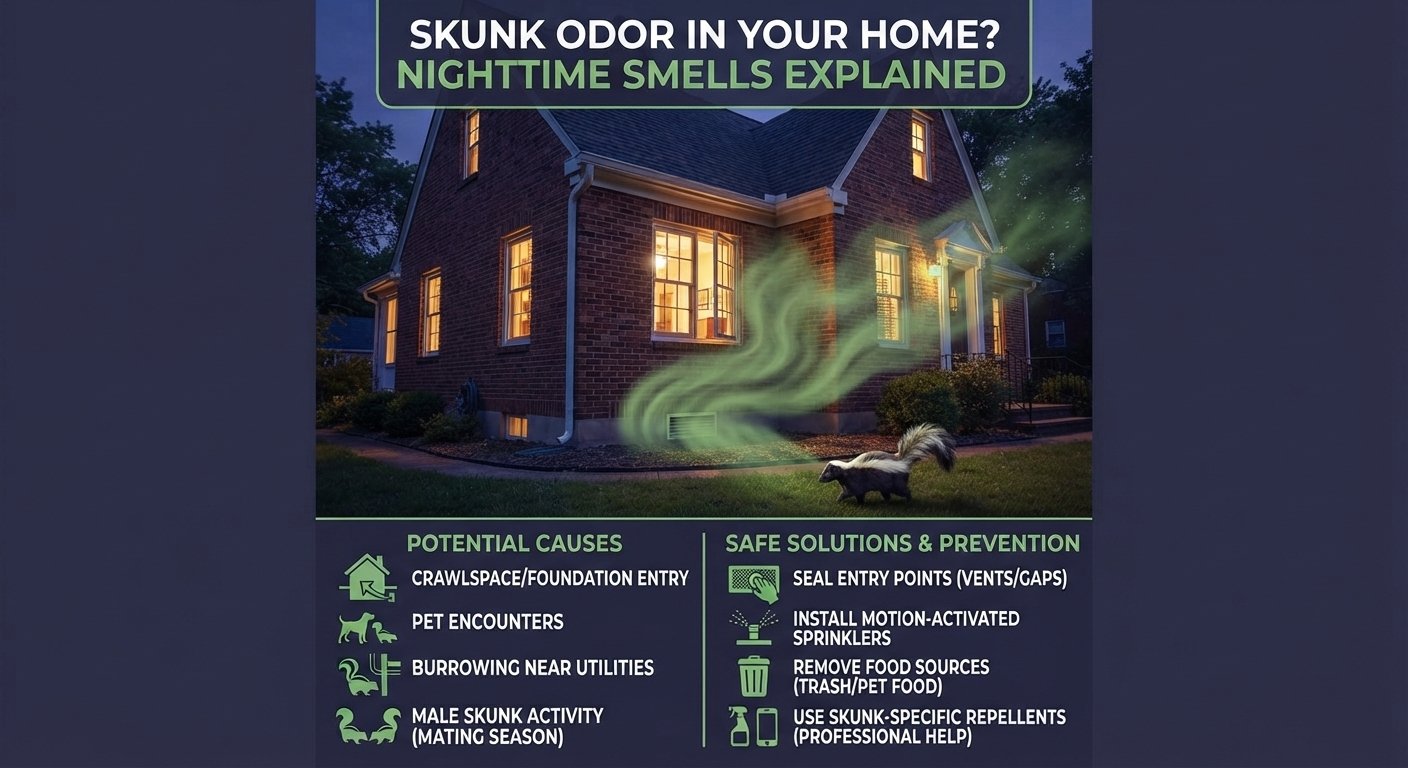
It can be shockingly hard to figure out what causes a potent skunk odor within your home to manifest solely in the nighttime hours. Though in this case the problem, truly, could be an actual skunk hiding outside your house–whether that be under the porch, by the foundation,or nearby the air vent opening. This points directly to the fact that skunks tend to be nocturnal, therefore, an evening prevalence is crucial.
Nonetheless, you must rule out other sources before assuming wildlife is to blame. The foul smell from Natural gas (odordant is added as a odorant), or sewer gas (which emanates rotten egg like or sulfur like smells can very easily be confused for that of skunk, just like any plumbing issue, dead animal, odors coming from contaminated air conditioning systems as well as from the outdoors.
If you are wondering why does my house smell like skunk at night, the safest approach is to identify the pattern before trying to eliminate the odor.A smell unmistakably from the outside, closest to your house’s foundation, will generally point you in another direction than one that popped up instantly by a gas range or in the form of forced air throughout your home. In the guide below, you will find a few likely causes, some clues as to the types you might detect, a few checks you can safely make on your own, and when a professional plumber or technician should take over.
The Most Common Reason: A Skunk Is Nearby
If you are wondering why does my house smell like skunk at night, skunks are nocturnal animals, which makes them particularly noticeable when the weather becomes quiet and outdoor activity decreases at night. They may travel through yards looking for insects, grubs, food scraps, or sheltered places to rest.
Skunks don’t need to get into your home for it to stink of them. If one sprays under your porch, against your garage, near your foundation, or near your house opening or vents, the smell can easily travel through tiny cracks in your structure.
Skunks will make their dens inside dark, protected spaces under homes and other structures, consistent with skunk behavior and wildlife management guidance.
University Extension notes that areas underneath structures, such as sheds and garages, are good den sites.
Signs that point toward an actual skunk
Look for several clues rather than relying on the smell alone:
- The odor is noticeably stronger outside than inside.
- It is concentrated around one side or corner of the property.
- The smell becomes obvious after dark and fades during the day.
- You notice small cone-shaped holes in the lawn from digging for insects.
- There are signs of activity beneath a deck, porch, shed, or other structure.
- The odor changes with wind direction.
- Your pet suddenly smells strongly of skunk after being outdoors.
You may find evidence such as small holes or damage patches in a turf patch which skunks use to dig when feeding on grubs and similar animals.
If the traces matches with the stench you may have an animal not in the house but close to it.
Why the Smell Can Be Stronger at Night
It is quite possible that its activity is due to its time of appearance, as a skunk is mostly active during nighttime, this might account for spraying or activity around your yard when your indoors and you are less aware of the presence.
If you are wondering why does my house smell like skunk at night, air movement can also change how an odor reaches your home.Odors that occur outside at afternoon may never reach to the building if they get carried away by wind. At some later point, a change in wind direction can carry them into windows, doors, vents, opening tocrawl spaceor holes.
Your air conditioning system can also add to the confusion. Outdoor odors can be noticeable inside if airflow change, or heat or cooling system circulates the air. According to Trane, skunky HVAC odors are often signs of gas leak, a dead animal, or infiltration of odors into the air system from the outside.
Thus, the presence of odor mainly at nights doesnt guarantee its location to be in that room.
Could a Natural Gas Leak Smell Like Skunk?
Yes, and this is the most important safety issue to rule out.
If you are wondering why does my house smell like skunk at night, natural gas itself does not naturally have the strong odor people associate with a gas leak.Suppliers of natural gas and other sources include odorants with sulfur compounds, enabling consumers to smell a leak, as explained in natural gas odorant and leak safety guidance. This odor has been likened to rotten eggs, sulfur, and even skunk odor.
This creates an uncertain intersection between an ordinary wild animal problem and a crisis occurring in a home. Do not attribute a sudden strong indoor odor to an animal if you smell it concentrated near a gas appliance or have identified it as a specifically gassy or sulfuric odor; it may not provide accurate distinction.
What to do if gas could be involved
Treat an unexplained indoor gas-like odor seriously.
If you smell gas or hear a blowing or hissing sound. Ready.gov recommends that you leave the area and don’t take any action that might cause an ignition source: do not linger to look around for the source of the gas, “Do not switch any electrical devices on or off, light a match, use a flame or anything that could cause a spark. Call your gas utility’s emergency service or 911 (or your country’s emergency service) once you are a safe distance from the building.”
Don’t try to find an apparent gas leak by experimenting near any stoves or pipes yourself – only a trained employee and technician can detect an actual leak.
This procedure is essential, even if you feel certain that you’re being sprayed by a skunk. An animal can’t do anything besides make you take a shower, but a dangerous gas leak might do the unthinkable.
Sewer Gas Can Also Create a Skunk-Like Odor
Another possibility is sewer gas entering the house through plumbing.
If you are wondering why does my house smell like skunk at night, a dry or damaged drain trap can allow odors from the drainage system to enter an occupied space. This is particularly common with fixtures that are rarely used, such as a basement floor drain, guest bathroom sink, utility sink, or seldom-used shower.
A Michigan State University Extension expert specifically identifies sewer gas from infrequently used or damaged drains as one possible explanation for a skunk-like smell inside a home.
The location of the smell is useful here.
If the odor is strongest around:
- A basement floor drain
- A shower or bathtub
- A bathroom sink
- A laundry area
- A utility room
- A toilet
- A drain that is rarely used
then plumbing deserves closer attention.
Let water run through disused taps. This may re-create water barrier within the traps. If smell persists, consider if the trap or joint is cracked, or if there is an issue with the drain, connections, sewer system or venting which would require further investigation. Don’t run unrelated chemicals down every drain trying to mask smells – that will merely alter what you’re smelling and won’t address the cause.
HVAC Problems Can Spread an Outdoor Odor Through the House
The issue may appear house-wide but originating from external air sources. Skunks spraying outside air intakes or any areas where air is channeled into the home (such as a crawlspace vent) will create a skunk odor. A deceased animal is also a cause; when animals get inside the ductwork or HVAC components, the odor may be unpleasant. Trane explains this under their discussion of the skunk HVAC smell.
How to narrow down an HVAC-related source
Pay attention to timing.
If you detect the smell significantly intensifies whenever your furnace, heat pump, or air conditioning unit runs it is possible that the system is distributing the smell from elsewhere. Identify the location of the smell in relationship to the supply registers, return air vents, the mechanical room, and externally.
If you believe your HVAC system has to have circulated a strong smell it is recommended to not constantly turn on and turn off your system to check the smell. Continued smells should be investigated, if not just to see if there may be an electrical short, a dead animal in your system, or if you simply might be dealing with gas vapors.
Your HVAC technician may be able to assess accessible parts of your systems, filter locations, condensate lines/drip pans, ductwork and your units themselves for a conclusive smell.
Other Possible Sources Inside or Near the House
Not every sulfurous or skunk-like smell has the same origin. Once gas and obvious wildlife activity have been ruled out, consider several less common possibilities.
A dead animal
Animals, such as a mouse, rat, squirrel, or other critter, can get trapped in wall, attic, crawl space, duct work, or chimney. As it decomposes, it’ll start to produce an even more offensive odor.
The odor may appear more acute or noticeable in one certain room, one certain wall or ceiling, or one certain ceiling fan or paneling that can be opened. Also when the air conditioner running will make it more noticed.
In a house or other building, if you think there’s an animal in the attic, wall space, duct work, ceiling area, chimney, etc., that cannot be gotten to without tearing into a wall; you should hire a wildlife removal service, or a pest control professional that can tell you where it is before going about tearing walls apart.
Odor brought indoors by a pet
A dog or cat which has met a skunk outside can bring the smell in on its fur, leading to a room which smells ‘doomed’.
Inspect pets, bedding-both inside and out-and resting spots, e.g. Baskets. If the smell follows the pet about rather than lingering in one place, this tip could save a lot of time.
Odors from neighboring properties

Smoke or strong odor can diffuse through common walls of apartments, townhouses, and closely built homes, through windows, vents, balconies, garage areas, or openings. Smoke smells related to cannabis may be similar to skunk. It’s considered possible by Trane that a smell similar to skunk spray could be from cannabis smoke. This smell may be temporary and the timing may be heavily influenced by the time of the night and/or the wind.
A Practical Way to Find the Source
Rather than spraying air freshener throughout the house, work backward from where the odor is strongest.
Step 1: Check outside first
Walk around the property from a safe distance and determine whether the odor is stronger outdoors.
Look near the foundation, porch, deck, garage, sheds, crawl-space openings, vents, and areas where animals could shelter.
Do not approach a skunk. If you see one, give it plenty of space and do not attempt to corner or chase it.
Step 2: Identify the strongest indoor location
Move from room to room and compare the odor.
Is it strongest near a bathroom? A gas appliance? An HVAC register? The basement? A garage? One wall?
The location can be more informative than the smell itself.
Step 3: Consider the timing
Ask whether the odor:
- Appears only at night
- Appears after the HVAC starts
- Occurs after using a shower or sink
- Happens when the wind changes
- Remains present all day
- Comes and goes unpredictably
A recurring pattern can reveal how the odor is entering the home.
Step 4: Rule out immediate safety concerns
If the smell is indoors and could reasonably be gas, stop investigating and follow gas-leak safety procedures. Do not assume that nighttime timing proves the odor is from wildlife.
Step 5: Inspect only safe, accessible areas
You can check filters, visible drains, obvious outdoor gaps, and accessible areas around the foundation. Avoid dismantling gas appliances, electrical equipment, or HVAC components.
How to Get Rid of the Smell Once the Source Is Known
Removing the odor works best when you remove or isolate its source first, just as home odor troubleshooting tips can help identify common causes before attempting to mask persistent smells.
If a skunk spraying occurred outside, ventilation and time eventually should diminish any noticeable odors. Porous items may hold odors longer than solid surfaces, so textiles, rugs, bedding (and even bedding of household pets), outdoor furniture, and other permeable articles may require separate cleaning efforts.
For denning skunks living under structures, exclusion, versus deodorizing, usually is most beneficial. Utah State University Extension recommends blocking likely entry sites and plugging desirable opening sites, subject to local wildlife control laws.
Avoid plugging and sealing an existing den without investigating if an animal or young reside within the den, as the successful exclusion of wildlife animals involves care not to trap an animal beneath a structure.
Should there be any concern for plumbing problems, repair the appropriate faulty drain trap, drain pipe, vent pipe, or sewer connection. Should the source be in HVAC system hardware, inspect the appropriate system rather than trying to cover up all odors by using air fresheners. Air fresheners, while potentially masking odors, have no impact on the odor source.
Common Mistakes Homeowners Make
One of the largest assumptions. Night doesn’t necessarily equal skunk. The time does correlate with skunk movement, however, it doesn’t mean that gas, sewer, HVAC or other household smells haven’t been present.
Second of all: do NOT try to located a possible gas leak on your own.
If the gas scent possibly has come from natural gas and has not been located the recommended approach is to evacuate the area and call utility/emergency service. Thirdly, slow down and think about all your infrequently used drains. A sink in an unused guest bathroom or in a basement does not get used often enough for its water barrier at the trap to be renewed and thus, water is lost allowing sewer gasses through. Lastly, many homeowners will just assume that the strongest smelling room is where it comes from, that simply isn’t the case.
Air systems, wall cavities and HVAC will quickly transmit odors to another room, or two or three and it seems like it’s from that particular room, however, the smell originates elsewhere.
When to Call a Professional
Professional assistance makes sense when the odor persists without an obvious explanation or when the suspected source is beyond a safe DIY inspection.
Contact the appropriate professional if:
- You suspect a natural gas leak.
- The smell is strongest near gas appliances or gas lines.
- The odor repeatedly comes through HVAC vents.
- You suspect an animal is trapped inside a wall, attic, crawl space, or duct.
- A sewer odor persists after checking rarely used drains.
- You find evidence of a skunk den beneath the home.
- The smell is accompanied by visible damage, unusual appliance behavior, or other warning signs.
It is the duty of a gas utility to respond to indications of potential gas leaks. If there are continuing problems with sewer or drainage odors, then a plumber would be required to deal with it. For odor-related problems with furnaces or air conditioning units the services of a HVAC technician should be sought, and if an animal is suspected or known to inhabit or dwell beneath a building, a wildlife removal service should be contacted to humanely manage the animal.
The key is matching the problem to the right specialist instead of repeatedly masking the odor.
Final Takeaway
If you’re wondering why does my house smell like skunk at night, the timing may point toward a nearby skunk because these animals are most active after dark. A skunk may have sprayed near the foundation, porch, deck, crawl space, or an outdoor air pathway.
Nonetheless, a smell noticed at night shouldn’t discount serious possibilities. Natural gas odorants can easily be confused with sulfur or skunk, and sewer gas can emit yet another misleading scent. Assess if the odor is stronger inside or outside, where it is most concentrated, and if it changes when the plumbing or HVAC is running.
If an undiagnosable smell in your building might be gas, vacate the premises, then call emergency services or your utility company-don’t explore it yourself!
After safety is ensured, getting the odor actually removed, whatever its source-an animal, the plumbing or HVAC, or just another odor– is your best bet toward making the stink cease.
Frequently Asked Questions
1.Why does my house smell like skunk at night but not during the day?
A nighttime-only odor can be caused by a skunk becoming active near the house after dark. The smell may also enter through windows, vents, crawl spaces, or small gaps when wind direction changes. However, sewer gas and natural gas can produce similar sulfurous odors, so an unexplained indoor smell should not automatically be attributed to wildlife.
2.Can a natural gas leak smell like skunk?
Yes. Natural gas is naturally odorless, so odorants are added to make leaks detectable. These sulfur-containing odorants can smell like rotten eggs, sulfur, or skunk to some people. If a strong skunk-like odor is indoors, especially near a gas appliance or gas line, treat it as a possible gas leak and leave the area rather than trying to locate the leak yourself.
3.Can sewer gas smell like skunk?
Yes. Sewer gas can contain sulfur compounds that produce unpleasant odors resembling rotten eggs or, in some situations, skunk. A dry P-trap, damaged plumbing connection, faulty toilet seal, or blocked plumbing vent can allow sewer odors into the house. A rarely used drain is a particularly useful place to check when the smell is strongest in a bathroom, basement, or utility room.
4.How can I tell if a skunk is living near my house?
Look for signs around porches, decks, sheds, garages, crawl spaces, and other sheltered areas. Persistent odor concentrated near one part of the property, nighttime animal activity, digging in the lawn, or evidence of an animal entering a sheltered space can suggest a nearby skunk. Avoid approaching or cornering the animal.
5.Can a skunk smell get inside through the HVAC system?
Yes. An outdoor odor can enter through air pathways and may become more noticeable when the heating or cooling system circulates air. If the smell becomes significantly stronger whenever the HVAC system runs, have the system and nearby air pathways inspected rather than assuming the odor originates from inside the equipment.
6.What should I do if I smell skunk inside my house?
First, determine whether the smell is stronger indoors or outdoors. Check for obvious wildlife activity, rarely used drains, and areas where outdoor air could enter. If the odor could be natural gas, particularly if it is strong or concentrated around gas equipment, leave the building and contact your gas utility or emergency services according to local procedures. Do not use switches, flames, or other potential ignition sources while investigating.
7.How long does skunk smell usually last in a house?
The duration depends on how close the spray occurred and whether porous materials absorbed the odor. Carpets, curtains, upholstery, bedding, and pet fur can retain smells longer than hard surfaces. Removing the source, increasing appropriate ventilation, and cleaning affected materials can help the odor fade more quickly.
Conclusion
If you’re asking why does my house smell like skunk at night, a nearby skunk is certainly one possibility, particularly when the odor appears after dark and is strongest near the exterior of the property. A skunk may spray close to the foundation, porch, deck, garage, or another sheltered area, allowing the smell to enter the home.
However, wildlife shouldn’t be the first factor assigned the cause of the odor. The same sulfur odors will emanate from sewer gases and natural gas, which both must be addressed for distinct reasons. First, you need to determine where the smell is emanating from, and more importantly if the source is outside, from plumbing,HVAC system flow, or other causes in your household. But MOSTLY-if you suspect it might be natural gas you call the gas company or emergency services instead of testing it for yourself-that’s step one!











