

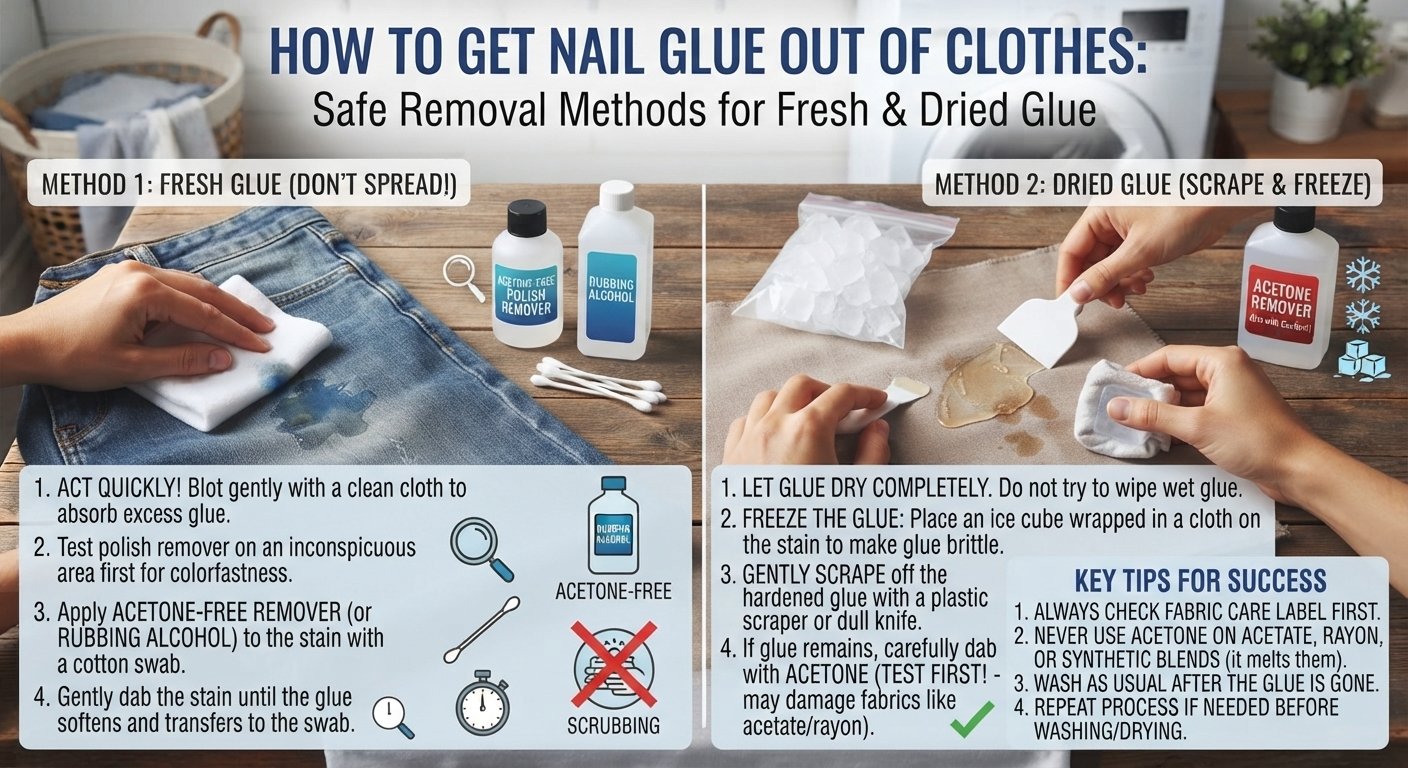
A single drop of nail glue can cause a hard to remove stain on your laundry. Nail glue is made of cyanoacrylate, a fast-setting bonding agent that sticks to warm moist surfaces instantly. It can be pretty difficult to wash away with regular detergent so that only a visit to the laundry can get the stain off.
Getting the nail glue off of your washables is possible with a few simple tricks. Work to ensure that you don’t spread the glue, always test your fabric before choosing a solvent, and be patient, because it can take a lot of scrubbing. Many solutions remove the glue from some fabrics, but permanently stain or ruin other types.
This guide explains how to get nail glue out of clothes, including what to do with fresh and dried glue, when acetone is appropriate, what alternatives are available, which fabrics require special care, and when it is better to take the garment to a professional cleaner.
Why Nail Glue Is So Difficult to Remove
Nail glue is different from many ordinary household stains. Instead of simply soaking into fabric, cyanoacrylate adhesive rapidly hardens and forms a strong bond.
When learning how to get nail glue out of clothes, it helps to understand how the adhesive behaves once it has cured. Once it has fully dried, it is literally a solid plastic consistency glued to the fibers – water alone, or even a normal laundry detergent, will not normally be able to pull that off. Instead, you might make things worse by scrubbing at the material – forcing the dried glue deeper into the fabric, or ripping apart some of the fiber itself.
While the dried glue is still flexible or semi-soft it is not the way to remove it; instead the solution is to mechanically agitate the glue first to “peel” as much of the glue off as possible, then attack the remainder with a solvent.
The fabric itself is just as critical to the successful removing of the glue as the actual glue; fabrics like cotton, denim, or even polyester can withstand a tested solvent, whereas finer or synthetic fibers require careful fabric stain removal methods.
What to Do Immediately After a Nail Glue Spill
If nail glue has just landed on your clothing, resist the urge to rub it with a paper towel or cloth.
When learning how to get nail glue out of clothes, place the garment somewhere safe and allow the glue to harden if it is still wet. Keep the stain part from the body of the garment so the glue will not be smudged. If there is a great deal of liquid glue, do not put another piece of fabric on top of the glued area. The absorbent substances will adhere to the glue and create a greater mess.
A critical safety point about cotton and wool
Certain natural fibers like cotton or wool may react extremely rapidly to cyanoacrylate and even produce a lot of heat. If you or your clothing get into a situation where Liquid Nail glue has soaked into cotton or wool clothing, don’t intentionally rub or wipe it with paper towels or onto cotton clothing. If the adhesive heats to the extent where smoke is produced, or it gets hot to the touch, you should remove yourself from the garment and cool it in a safe and contained manner.
If there is a large saturation onto cotton or wool, consider professional cleanup.
How to Get Nail Glue Out of Clothes After It Dries
Once the adhesive has fully hardened, start with mechanical removal rather than immediately reaching for acetone.
Step 1: Let the glue become completely hard
Do not try to remove a sticky or partially cured patch by force. Give it time to harden.
A completely cured spot is easier to lift from the surface without spreading it.
Step 2: Gently scrape the excess
Use the edge of a dull butter knife, spoon, plastic scraper, or similar blunt tool to lift hardened glue.
Work slowly from the outside of the spot toward the center. The goal is to remove raised adhesive without cutting or pulling the fabric.
Avoid sharp blades whenever possible. A razor or knife can slice fibers even when the glue itself comes away successfully.
Step 3: Check the fabric label
1. Know what kind of fiber and how to care for the garment before any chemical solution is used.
Select garments made of cotton, polyester, nylon, rayon, acetate, triacetate, silk, wool, or blends. Synthetic fibers are relevant because some solvent solutions can be destructive to them.
Think about whether the garment is heavily colored, printed, or dark. Also, the solvents used to dissolve glue may change the color or surface of the material.
Step 4: Test the solvent
Test acetone if using. Use sparingly to a hidden seam or inside edge. It’s a lot better than on the garment’s visible part.
Watch this little application! Look out for it bleaching or transferring color, surface etching, surface breaking, weakening or other fabric change.
If the fabric doesn’t like it, give up.
Step 5: Treat the remaining adhesive
If the fabric is compatible with acetone and the test produces no damage, apply a small amount to the adhesive rather than soaking the entire garment.
Work from the outer edge inward. Allow the solvent a short time to act, then gently loosen the softened adhesive with a suitable tool.
Use small amounts rather than flooding the fabric.
Step 6: Rinse or wash according to the care label
Once the glue has been removed, launder the garment according to its care instructions.
When learning how to get nail glue out of clothes, do not place the clothing in a dryer until you have confirmed that the adhesive and any associated residue are gone. Heat can make some stains more difficult to deal with and can potentially set residues or cause further fabric damage.
Can Acetone Remove Nail Glue From Clothing?
Acetone is one of the best solvents that work well with a cyanoacrylate glue, so it’s often used on dried nail glue. It can dissolve or weaken the glue so that you can remove it easier mechanically.
But acetone is not safe for every fabric.
When learning how to get nail glue out of clothes, remember that some fibers and fabric finishes can be damaged by acetone. Acetone can also remove or alter certain dyes, coatings, prints, and finishes. Acetate and triacetate fabrics are particularly important to avoid because acetone can dissolve or severely damage these fibers.
For that reason, never assume that because a nail polish remover is sold for use on fingernails, it is automatically suitable for clothing.
Pure acetone versus nail polish remover
Products marketed as nail polish remover can contain ingredients other than acetone. Some are acetone-free and use different solvents, while others include conditioners, fragrances, oils, or other additives.
A remover labeled “acetone” may therefore behave differently from an acetone-free nail polish remover.
If a clothing manufacturer recommends avoiding a particular solvent, follow the garment’s care instructions instead of relying on a general stain-removal trick.
How to Use Acetone Carefully
7. Allow the Smallest Amounts of Acetone, if You Know That the Fabric Is Acceptable and the Hidden-Area Test Has Worked 8. Cover the Fabric with a Clean, Absorbent Cloth or Paper Towel, if the Fabric Is Suitable. This gives your softened adhesive an opportunity to transfer onto something absorbent, rather than traveling further into the garment 9.
Lightly use a small amount of acetone on the glue, working the gently while the glue begins to loosen 10.
Keep the absorbent material under the paper or cloth in place as the residue transfers. Do not rub back and forth as this will distribute the liquefied glue further and could damage the fabric.
Once the adhesive is gone, follow the garment’s washing instructions.
What If You Do Not Want to Use Acetone?
Acetone is not the only possible approach, particularly when the fabric is delicate or the garment is valuable.
For a small amount of hardened glue, careful scraping may remove most or all of the adhesive without any solvent. This is the least chemically aggressive option.
When learning how to get nail glue out of clothes, a commercially available adhesive remover may also be appropriate, but the product must be compatible with the specific fabric. Always read its label and test it on a hidden section before applying it to the visible stain.
Dry Cleaning Is Better for Fine Clothing such as silk, specialty fabrics, costly formalwear or items with elaborate finishes, may warrant professional dry cleaning. Skip Careless Home Substitutes Just because they are powerful solvents, that doesn’t mean you should use various household substances in a pinch. A glue dissolver is also a fabric dissolver, with likely dyes, prints and finishes.
What About Acetone-Free Nail Polish Remover?
Acetone-Free Nail Polish Remover While acetone-free remover is often claimed to be a safer/softer option, “safe on everything” is not a guarantee. Different solvents on the market have different effects on certain fabrics. Some won’t do much to a cyanoacrylate, but will damage dyes or synthetic fabrics.
If you decide to try an acetone-free remover, treat it as a chemical solvent like any other and adhere to any precautions noted on the label, conduct a small-area test for any fabric and look at the ingredients to ensure it’s suitable.
Consider using an adhesive removers that contains only a glue-removing agent, rather than a cosmetic product you must try repeatedly.
Removing Nail Glue From Different Types of Fabric
The safest method depends heavily on the material.
Cotton
Cotton is typically more resilient than many fine fabrics, but the interaction of the cyanoacrylate and cotton is worth taking into account while the glue remains in liquid form. When the glue is set, try gently scraping away the glue as a first step. If you plan on using a solvent, make sure to test it because the fabric dye might discolor even if the cotton fibers do not fall apart.
Denim
Denim is quite strong, so some solvents may not have much of an effect. Always try on a hidden section of the denim first. Since denim is woven strongly, mild abrasive rubbing can often remove a lot of dry glue before you need to resort to a solvent.
Polyester
Polyester can tolerate some cleaning methods better than delicate natural fabrics, but it is not automatically resistant to every solvent. Test first, especially on brightly colored garments.
Nylon
Nylon can be sensitive to certain chemicals and heat. Avoid assuming that acetone is safe simply because the garment feels durable.
Silk
Silk requires a much more conservative approach, which is why proper silk fabric care is important when treating stains. Avoid aggressive scraping, harsh solvents, and vigorous rubbing. A professional cleaner is often the safest option for an expensive silk garment.
Acetate and triacetate
These fabrics are particularly important because acetone can seriously damage them. Do not use acetone unless the manufacturer specifically confirms compatibility.
If the garment contains acetate or triacetate, professional cleaning is a safer option.
Wool
Wool requires care because of both the fiber itself and the potential reaction between liquid cyanoacrylate and natural fibers. If the spill is significant, professional treatment is preferable.
Common Mistakes That Can Make the Stain Worse
Rubbing wet glue
This is one of the easiest mistakes to make. Rubbing can spread liquid adhesive and increase the affected area.
Allow the glue to cure when practical, then remove the hardened material carefully.
Pulling at the fabric
Trying to peel off a strongly bonded piece of glue by force can pull fibers out of shape. If the adhesive does not release easily, use a suitable solvent or seek professional assistance.
Pouring acetone directly onto the garment
More solvent is not necessarily more effective. Excessive acetone can spread dissolved glue and increase the chance of affecting the surrounding dye or fabric.
Use a controlled amount.
Skipping the patch test
Even if acetone worked on another shirt, that does not mean it is safe for the garment in front of you.
Fabric blends, dyes, coatings, and finishes vary.
Using heat to speed up removal
Do not use an iron, hair dryer, or other heat source to soften nail glue on clothing. Heat can create additional risks and may damage the fabric.
Washing before removing the adhesive
A washing machine is unlikely to dissolve cured nail glue. Washing first can also make the stain harder to evaluate and may spread residue.
Remove as much adhesive as practical before laundering.
What If Nail Glue Leaves a White or Cloudy Mark?
Sometimes, after the glue has been chipped off, there is a white, cloudy, or faintly glossy ring. That is not necessarily due to a thick coating of the glue. It may be a thin coating or film left after the destruction of the adhesive; or the fabric surface itself may have been affected by the solvent.
Do not rush into a stronger chemical.
Start by assessing the finished surface under good light against the surrounding fabric to see if enough is left to tackle with a more delicate approach. There is often enough gluelike residue to see where one can start working carefully with slightly more powerful agents, if the fabric allows. Sometimes, the residue left is too faint to have been caused by the glue; it may be best to leave it to dry, and not introduce any more solvents that may disturb the remaining fabric color.
When Should You Take the Clothing to a Professional?
Professional cleaning is worth considering when the garment is expensive, delicate, sentimental, or difficult to replace.
It is also the better choice if you do not know the fabric composition or the adhesive has spread over a large area.
Seek professional help if:
- The garment is made from silk, acetate, triacetate, or another delicate material.
- The clothing has a special finish or complicated decoration.
- The glue has soaked deeply into the fabric.
- You have already tried several removal products.
- The fabric has started to discolor.
- The garment is expensive or sentimental.
- You are uncertain whether a solvent is compatible with the material.
Tell the cleaner exactly what happened and identify the nail glue product if you still have its packaging. Knowing the adhesive involved can help determine the appropriate treatment.
How to Prevent Nail Glue From Getting on Clothing
Although repairing a glue spill can be done with a bit of effort, preventing one is much easier. When working on your nails, avoid doing so on a carpeted or other undesirable work surface. It’s best to wear an apron, shirt, or old t-shirt whenever possible since some liquid adhesives can damage fabrics.
Keep the bottles of nail glue well capped and store them where they can’t easily fall and break. Try to keep them away from drying towels and clothing so that accidental spills, if they happen, aren’t on something irreplaceable.
If you do a lot of your own manicures, you may want to set aside a specific, washable work table for this purpose. Doing this can help prevent serious reactions in any household members should a bottle ever be dropped and the adhesive spilled.
Final Takeaway
Knowing how to get nail glue out of clothes starts with patience rather than aggressive scrubbing. Let fresh adhesive cure when appropriate, then gently scrape away as much hardened material as possible.For acetone The simple answer…sometimes but be aware that there are fabrics it will attack as well as acetate, triacetate, dyes, prints and some finishes. Read your care label and always try your solvent on an inconspicuous area first.
If in doubt take the garment to a professional where they will be able to treat it safely. The Golden Rule – take your time and remove the adhesive gradually. Never use anything that is not compatible with the fabric and end if the material stops behaving.
FAQs
1. Can nail glue be removed from clothes?
Yes, nail glue can often be removed from clothing, especially after it has fully hardened. Gently scrape away the dried adhesive first, then use a fabric-compatible solvent if necessary. Acetone can work on some fabrics, but it should always be tested on a hidden area first.
2. Does acetone remove dried nail glue from clothing?
Acetone can soften and break down cyanoacrylate nail glue, making it easier to remove. However, it can damage certain fabrics, dyes, and finishes. Avoid using it on acetate and triacetate fabrics, and always check the garment’s care instructions before treatment.
3. Can I wash clothes with nail glue on them?
Washing alone usually will not remove fully cured nail glue, so practical laundry stain removal tips can be useful when treating adhesive marks. It is better to let the adhesive harden, carefully scrape off the excess, and treat any remaining residue before laundering the garment according to its care label.
4. How do you remove nail glue without acetone?
For small amounts of dried adhesive, carefully scraping it with a dull tool may be enough. You can also consider a fabric-compatible commercial adhesive remover. Always test a product on an inconspicuous area first, particularly with colored or delicate clothing.
5. Can nail glue damage clothing?
Yes. Nail glue can bond strongly to fabric fibers, and attempting to remove it aggressively may cause pulling, fraying, or discoloration. Liquid cyanoacrylate can also react strongly with certain natural fibers such as cotton and wool, so spills on these materials require particular caution.
6. Should I use nail polish remover on a nail glue stain?
Only if the product and fabric are compatible. Some nail polish removers contain acetone, while others do not. Acetone may dissolve nail glue but can also damage certain synthetic fibers, dyes, and finishes.Always check the ingredients and perform a patch test first.
7. What should I do if nail glue gets on a delicate garment?
Avoid experimenting with strong solvents or vigorous scraping. For silk, acetate, triacetate, expensive formalwear, or sentimental clothing, taking the garment to a professional cleaner is generally the safer choice. Tell the cleaner that the stain is cyanoacrylate nail glue.
Conclusion
Getting nail glue out of clothing is generally easier if you refrain from scrubbing or pulling at the stain as you clean. First, allow the glue to set, then use a edge or smooth tool to carefully peel or scrape off as much glue as possible, then work to select a cleaner that is least likely to damage the clothing. Acetone can be used, but remember that is not a home and dry cleaning responsible solvent for all fabric types and can cause discoloration or damage.
For high-value fabrics, especially expensive clothing or items with sentimental value, seek out professional dry cleaning as the safest option.
The key to successfully removing a small nail glue accident is to go slowly and do a test patch before employing any cleaning products.











