

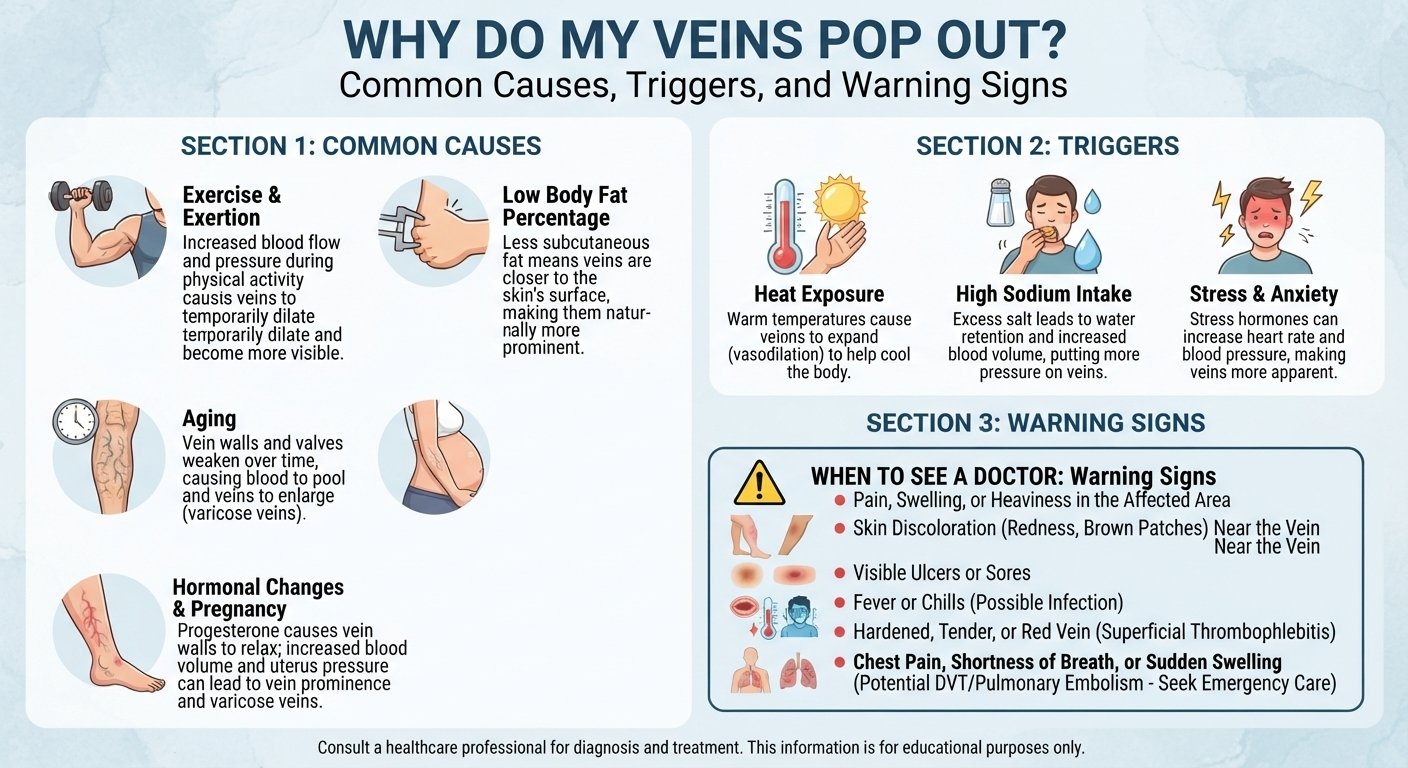
Visible Veins Can Be Surprisingly Prominent It can be startling to suddenly notice prominent veins appearing on your hands, arms, chest, and legs. Often, the reason is simple: Exercise, heat, lower body fat, older age, and prominent superficial veins can all make blood vessels much more visible beneath your skin.
What may look like a bulging vein after a rigorous workout can quickly become less prominent once your skin and body temperature cool down. However, a new, swollen vein that is becoming more prominent even without activity merits special attention.
A new, swollen vein that is more prominent than usual is one thing. A swollen vein that continues to be swollen, painful, warm, and red, or your arm or leg is swollen, is another.
So, why do my veins pop out? The answer could be a simple variation in the normal circulation to abnormal changes as in varicose veins or other vascular abnormalities. Knowing where these veins are located, when they seem, their appearance and presence of other symptoms can guide you in determining if a cautious eye is appropriate or a visit to the doctor.
What Does It Mean When Your Veins Become More Visible?
Veins lead blood back toward the heart. Other veins are deep in the body, while superficial veins are located closer to the surface of the skin. When a superficial vein enlarges or there is an increase in blood volume flow, the superficial vein can become more prominent.
If visible veins do not indicate that there is an underlying health issue, as they can be genetic, result from the thickness of the skin, the amount of tissue, or the vein’s location. The visibility may also vary from time of day to time of day, such as increased blood flow after physical activity or increased blood vessel diameter, causing the superficial veins to stand out more, as exercise causes blood vessels to widen to supply oxygen to the muscle tissue.
What prominent veins may look like
Normal visible veins can appear:
- Blue, green, or bluish-purple beneath the skin
- Straight and relatively flat
- More noticeable after exercise
- More visible in warm conditions
- Prominent on the hands or forearms
- Less noticeable after resting or cooling down
Varicose veins are distinct in appearance. They are large, swollen, circling veins that often occur on the legs. They tend to be rope-like, or knotted and raised, instead of just visible through normally tanned skin.
Why Do My Veins Pop Out After Exercise?
Exercise is one of the most common reasons veins suddenly become more noticeable.
Because working muscles demand more blood supply during exercise, the blood vessels expand to deliver it. But that’s not all. Exercise can fill your muscles also, which temporarily pushes the veins closer to your skin. All that can create prominent veins in your arms, shoulders, hands or legs that are just not there when you are not working out.
You particularly see the effects when weight lifting. You might be aware of veins in your forearms, biceps and/or hands right after you finish working out with arm exercises. It does not mean the veins are unhealthy; typically, they will fade as you get back to your resting condition.
Why body composition can make a difference
Deeper layers If you have less fat just under the skin, your veins may be more visible than someone with a thicker layer of tissue between the skin and veins. This thinner barrier puts the blood vessel closer to the surface of your skin so you can see it. Cleveland Clinic includes as a contributor to more prominent veins that an individual has a lower body fat percentage.
You and someone else with roughly the same circulation may look very different because of variations in anatomy.
Heat Can Make Veins Look More Prominent
Temperature can affect the appearance of blood vessels.
As our bodies heat up, blood vessels close to the skin can dilate as the body works to regulate its temperature. Similar dilation occurs during exercise, as muscle needs more blood flow.
You may therefore notice more visible veins after:
- A hot shower
- Spending time outdoors in hot weather
- Exercise
- Sitting in a warm room
- Using a sauna or hot tub
Once your body cools down, the vessels may become less prominent.
This temporary pattern is generally different from a persistently enlarged, twisted vein that remains visible regardless of temperature or activity.
Aging Can Make Veins Easier to See
Symptoms and signs: Is that irregular vein a problem? Your veins may become more visible with age. Skin also becomes thinner and less elastic with time, meaning things under the surface may be seen more readily than before. Also aging may make developing varicose veins more likely, as the walls of your veins and their valves weaken.
And just because a vein has become visible in an older adult doesn’t mean a more serious condition is imminent.
What would be more relevant is whether the appearance of a vessel is only a gradually growing cosmetic issue, or if it’s doing so with swelling, pain, increased warmth, discoloration of the skin, or a sensation of heaviness in the affected limb.
A clear vein that isn’t painful or bothering you may require nothing more than watching it. A vein that’s getting larger, more painful and increasingly inflamed should be seen by a physician.
When Prominent Veins May Be Varicose Veins
Varicose veins, usually in your legs, happen when your veins become larger and twisted, and understanding varicose vein symptoms can help you recognize when they may need medical attention. Good, healthy vein valves help blood continue to flow toward the heart. If those valves weaken or leak, the blood can pool in the vein, raising the pressure and causing the vein to enlarge.
What’s the difference between a varicose vein and a regular visible vein? A varicose vein is more likely to be bulging, twisted, or rope-like than the normal vein.
They may be accompanied by:
- Aching or soreness
- A heavy feeling in the legs
- Swelling around the ankles or lower legs
- Itching
- Muscle cramping
- Skin color changes around the affected vein
You may notice your symptoms worse when you’ve been sitting or standing for a long period of time. Your legs are the most common sites for varicose veins, as the veins in your legs have the task of pumping blood back to your heart, against gravity.
Who is more likely to develop varicose veins?
There are several things that may increase the risk of a vein disorder. These factors include but are not limited to: family history, old age, pregnancy, lack of movement such as sitting or standing for extended periods, hormonal factors, smoking, and excess weight or obesity. If you have one or more risk factors, this does not mean you will develop a vein disorder.
Why Are the Veins on My Hands Suddenly More Visible?
If you notice hand veins that are really prominent, there may be less tissue covering some superficial veins (closer to the surface of your skin). They may also stand out more with activity, heat, your body shape and size, and normal anatomical variation. However, if the veins become prominent when you’re exercising and then return to normal, it is consistent with the change in blood flow leading to dilation of the blood vessels.
As you get older, the skin and tissues over your hand can thin as well, making them easier to see.
If this is new and there’s no swelling, redness, pain, warmth, and a noticeable difference between your hands, it can be dismissed as prominent hand veins.
Why Are the Veins on My Legs Popping Out?
Leg veins that are visible will garner slightly more attention as legs are common sites for varicose veins and other venous conditions. A superficial flat and thin vein that flushes out with exercise or heat may not be problematic. A vein that is raised, swollen, twisted, and/or combined with aching and swelling in the leg may be better suited to varicose veins.
Sitting or standing for long stretches of time can create issues with the return of blood from the legs.
Movement allows the musculature of the lower leg to assist with venous blood, whereas no movement can allow blood to sit in the lower extremities for an extended period. If noticeable veins of the leg are becoming increasingly bothersome, a medical professional can identify whether they are purely superficial veins or venous issues.
Other Factors That Can Make Veins Stand Out
Not every visible vein has the same underlying cause.Several ordinary changes can influence how prominent your veins appear.
Physical activity
Exercise increases circulation and can temporarily make veins more noticeable, particularly in the arms and hands. Strength training can produce a particularly obvious effect.
Body composition
Less tissue between the skin and superficial veins can make those vessels easier to see. This is one reason visible veins are sometimes more noticeable after changes in body composition.
Genetics
Some people simply inherit vein patterns that are more visible. Family history also plays a role in the likelihood of developing varicose veins.
Pregnancy and hormonal changes
Since pregnancy increases the volume of blood in your body and puts more stress on your circulation, as well as shifting your hormones can influence the walls of the veins. This means veins and varicose veins may be more prominent.
Prolonged sitting or standing
Remaining in one position for long periods can contribute to venous blood pooling in the legs. Regular movement can support circulation and may help reduce symptoms associated with venous problems, along with practical circulation health tips.
When Are Bulging Veins a Warning Sign?
It’s not necessarily an emergency if the veins are only visible. It is the other symptoms that are way more important.
New or altered veins should be evaluated by a healthcare professional when they are related to ongoing pain, swelling, heat, redness, skin discoloration, bleeding, or a lot of pain. These symptoms may be seen with varicose veins and other vascular disease.
A critical difference that is all too easy to overlook is the difference between the fleeting visibility of a small vein and the sudden and painful swelling of an entire limb.
DVT Swelling, pain or tenderness, heat and redness or discoloration of the skin in an affected arm or leg. For tips, visit CDC’s Get Ahead of Clots page and Seek Care if You Notice a Symptom on CDC’s Symptoms page.
Emergency symptoms
Blood clots can also break free and travel to the lungs resulting in pulmonary embolism. Immediately see a doctor if you experience unexplained sudden shortness of breath, chest pain that worsens with deep breaths or coughing, a fast or irregular heartbeat, coughing up blood.
These symptoms should not be attributed to ordinary visible veins.
How to Evaluate a New Prominent Vein
If you notice a vein that suddenly looks different, take a moment to consider the pattern rather than immediately assuming the worst.
1. Look at where it appears
Hands and forearms commonly have visible superficial veins. Legs are also common locations for varicose veins.
2. Consider what you were doing
If the vein appeared after exercise, heavy lifting, or exposure to heat, temporary vascular changes may explain the appearance.
3. Check whether it changes with rest
A vein that becomes less prominent after cooling down and resting is different from one that remains enlarged.
4. Look for other symptoms
Pain, swelling, warmth, redness, skin discoloration, tenderness, or a heavy feeling can provide important clues.
5. Compare both sides
A noticeable difference between the two limbs can be more useful than the appearance of one vein by itself. A new swollen arm or leg should receive medical attention, particularly if pain or warmth is also present.
This simple observation does not diagnose a condition, but it can help you describe the change accurately to a healthcare professional.
What Can You Do About Prominent Veins?
Treatments for visible veins If visible superficial veins are not associated with any symptoms, you may not require treatment as they can be a normal anatomical variation. Lifestyle modifications Certain lifestyle modifications can help to reduce symptoms in people with varicose veins or venous symptoms: movement is key, as sitting and standing for long periods helps promote venous flow through the legs. Raising your legs may help to reduce any venous pressures and swelling.
Compression stockings have benefits for some venous conditions, but they aren’t suitable for all so this can be something to discuss with your doctor.
Avoiding long periods of sitting or standing can be useful, and if you have a desk-based role, regular movement breaks can be practical. Whilst these may reduce symptoms, they are less likely to resolve an established varicose vein. When symptoms become severe or treatment is sought for another reason, other interventions are available.
Common Mistakes People Make About Visible Veins
Don’t assume all prominent veins are varicose veins: superficial veins can be prominent in healthy people, especially in thin people, athletes and others who may have naturally thin skin. Don’t assume that a painful swollen vein is nothing to worry about just because it’s in plain sight: swelling, warmth, redness or unexplained tenderness can be a sign of a more serious vein problem. Don’t look at the color of the veins without considering their shape, symptoms, shape and location: blue and green veins can be normal. Don’t expect regular exercise to get rid of established varicose veins: physical activity may be beneficial in supporting circulation and immediate appearance but it’s not going to make the veins go away.
When Should You See a Doctor About Popping-Out Veins?
Follow up with a health professional if you have a vein that is very enlarged, progressively more prominent, painful, or associated with swelling or skin changes. Consultation is particularly important if you are experiencing recurrent leg pain, heaviness or tiredness, itching around visible veins, or skin changes near them. These symptoms are characteristic of varicose veins or other venous diseases.
Seek urgent care if you experience swelling, pain, redness, or warmth in an arm or leg, as these symptoms can indicate deep vein thrombosis (DVT).
Do not delay getting treatment if you experience symptoms of a pulmonary embolism, including sudden onset shortness of breath, chest pain, or coughing up blood.
Final Takeaway
If you’re wondering why do my veins pop out, the cause is often something relatively ordinary, such as exercise, heat, body composition, aging, or naturally prominent superficial veins. A vein that becomes temporarily more visible after a workout and settles afterward is generally different from a persistently swollen or twisted vein.
Watch for pain, swelling, warmth, redness, skin changes or tenderness along with visible veins. This can be a sign of a vein disorder and in some cases should be checked immediately. Sudden swelling in a limb with pain or warmth may indicate a blood clot, or pain in the chest or sudden difficulty breathing could be a health emergency. If it’s new, persistent or of concern, a doctor will tell if it’s a visible superficial vein or a condition that needs treatment.
FAQs
1.Why do my veins pop out suddenly?
Veins can suddenly become more visible after exercise, heavy lifting, heat exposure, or changes in blood flow. Lower body fat, naturally prominent veins, and thinner skin can also make them easier to see. If the change is persistent or occurs with pain, swelling, warmth, redness, or tenderness, medical evaluation is appropriate.
2.Is it normal for veins to pop out after exercise?
Yes. During exercise, blood flow to working muscles increases and blood vessels widen. Muscles can also temporarily become fuller, making superficial veins more noticeable. In many cases, the veins become less prominent once you stop exercising and your body cools down.
3.Why are the veins on my hands suddenly more visible?
Hand veins are often close to the skin’s surface, so they can become prominent with exercise, heat, aging, or changes in body composition. If one hand suddenly becomes swollen, painful, warm, or noticeably different from the other, seek medical advice.
4.Does having visible veins mean I have a health problem?
Not necessarily. Visible veins are common and can be a normal feature of your anatomy. The appearance of the vein alone is less concerning than symptoms such as persistent pain, swelling, warmth, redness, skin discoloration, or a vein that becomes enlarged and twisted.
5.Why do my leg veins stick out?
Prominent leg veins can result from normal superficial veins, exercise, heat, body composition, or genetics. Raised, twisted, rope-like veins may be varicose veins, particularly when accompanied by aching, heaviness, swelling, itching, or skin changes.
6.Can dehydration make veins more visible?
Changes in hydration and fluid balance can affect how prominent veins appear, but visible veins have many possible explanations. Exercise, body composition, heat, and anatomy can also contribute. Persistent or symptomatic vein changes should not be attributed to dehydration alone.
7.When should I worry about a bulging vein?
Seek medical evaluation if a newly prominent vein is painful, swollen, warm, red, tender, or associated with swelling of the surrounding arm or leg. Sudden limb swelling and pain can be symptoms of deep vein thrombosis and require prompt medical attention.
8.Can exercise get rid of prominent veins?
Exercise can support healthy circulation and may help with some symptoms associated with venous problems, but it does not necessarily make established varicose veins disappear. If visible veins are causing discomfort or continuing to worsen, a healthcare professional can discuss appropriate treatment options.
Conclusion
If you’re asking why do my veins pop out, the explanation is often harmless.Exercise, heat, excess fat in the legs, aging, genetics and naturally superficial veins can all cause a blood vessel to be more visible. But the best way to recognize a problem is to notice something else about the vein, not just its visibility. If it’s obvious during exercise but disappears afterward, it’s likely not serious.
A swollen, painful, twisted vein that doesn’t go away is a different matter altogether, as is a more prominent vein in the leg, where varicose veins are commonplace.
Seek prompt medical attention for unexplained pain or swelling in a leg, or for warmth or redness in a limb, and call 911 immediately if you experience sudden chest pain or shortness of breath.











