

If you searched “precipitating factors include all except,” you are probably looking at a multiple-choice question with these options:
- An individual’s past experiences
- Environment
- Sense of control
- Rigid rules
The short answer commonly given online is an individual’s past experiences. That answer follows the usual distinction between predisposing factors and precipitating factors: past experiences often create vulnerability or influence how someone interprets a situation, while precipitating factors are more immediate events or conditions that contribute to the onset or escalation of a problem.
However, there is an important limitation. The exact correct answer for a precipitating factors include all except PMDB test question should be checked against the wording in the official course module. Online answer platforms repeat the same four options, but many do not identify or cite the original training source. This guide explains how to reason through the question rather than relying blindly on a copied answer key.
What Are Precipitating Factors?
A precipitating factor is an event, change, stressor, perception, or condition that helps trigger the beginning or worsening of a problem. In mental-health case formulation, precipitating factors are usually recent and closely connected to the current difficulty.
For example, a person may be coping adequately until a sudden conflict, a stressful environmental change, a major loss, or a frightening physical sensation occurs. That immediate event may contribute to distress, escalation, or a behavioral crisis. It does not mean one factor is the sole cause. Human behavior and mental health are shaped by many interacting influences.
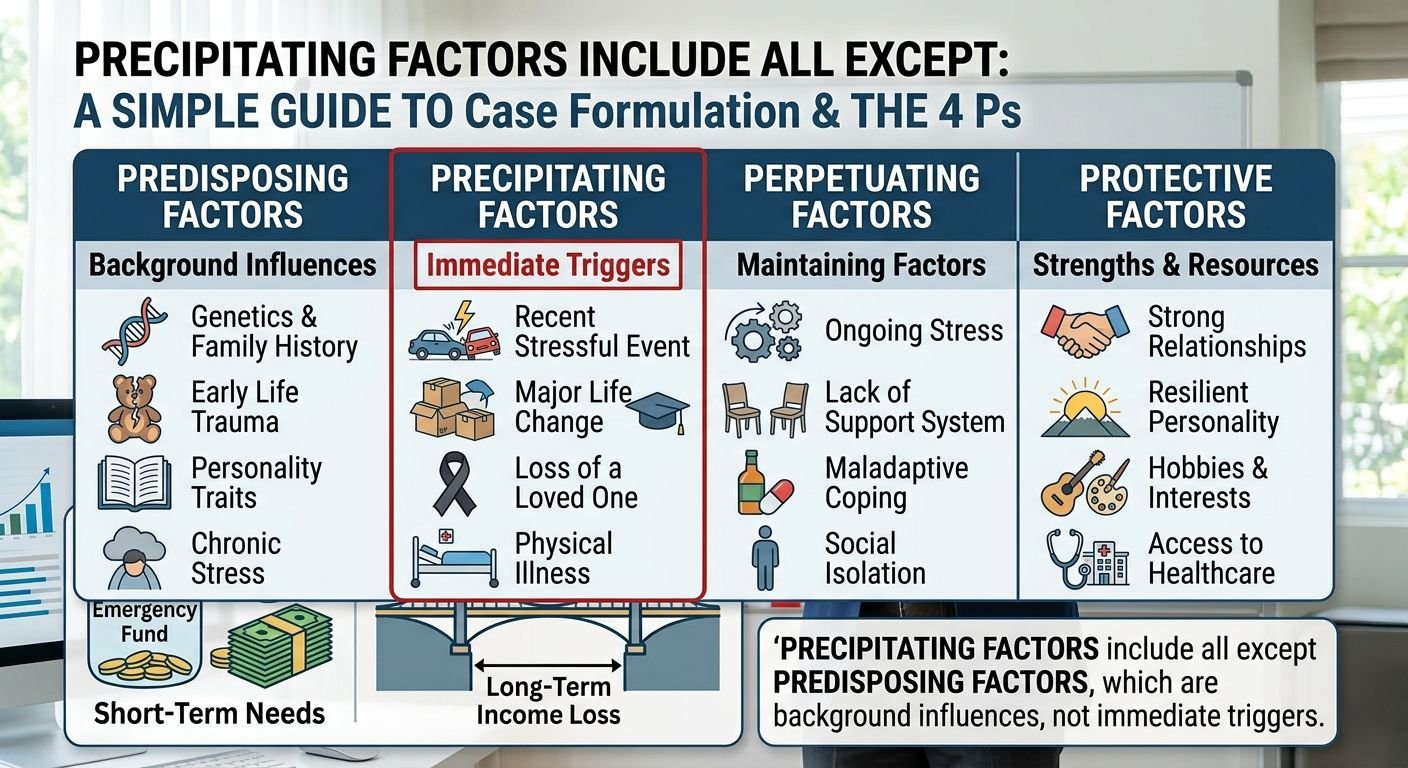
The term appears in the case formulation framework used in case formulation:
- Presenting problem: The current difficulty or reason for support.
- Predisposing factors: Longer-term vulnerabilities that may increase risk.
- Precipitating factors: Immediate triggers or events linked to onset or worsening.
- Perpetuating factors: Conditions that keep the problem going.
- Protective factors: Strengths, resources, and supports that reduce risk.
Precipitating Factors Include All Except: The Usual Answer
In the common question format, an individual’s past experiences is usually the option that does not fit under precipitating factors. Instead, it is more often classified as a predisposing factor.
Past experiences can shape a person’s expectations, coping patterns, stress response, trust, and perception of safety. But if those experiences happened long before the current incident, they are typically a background influence rather than the immediate trigger.
By contrast, environment, a reduced sense of control, and rigid rules can all contribute to a person’s reaction in the moment. Whether a particular course labels every one of those choices as a precipitating factor depends on its definitions, which is why learners should review the official PMDB material before submitting a graded response.
Predisposing vs. Precipitating Factors
The easiest way to understand the phrase “precipitating factors include all except” is to separate long-term vulnerability from immediate triggers.
| Factor type | What it means | Timing | Example |
| Predisposing factor | A background condition that may increase vulnerability | Exists before the current incident | Past experiences, long-term stress, health history |
| Precipitating factor | A recent trigger connected to onset or escalation | Occurs close to the current problem | Argument, crowding, sudden change, confusing communication |
| Perpetuating factor | Something that maintains the problem | Continues after the problem begins | Ongoing conflict, avoidance, lack of support |
| Protective factor | A resource or condition that reduces risk | May exist before, during, or after a problem | Clear choices, social support, coping skills |
Clinical and behavioral frameworks generally describe predisposing factors as influences that make a person more vulnerable and precipitating factors as events that trigger or intensify the presenting problem.
A useful memory cue is:
Predisposing factors set the stage. Precipitating factors start or worsen the current episode.
This does not mean past experiences are unimportant. They can strongly shape how a person experiences a present-day event. The distinction is about their role and timing, not their importance.
How to Reason Through the Question
When a test asks, “precipitating factors include all except,” do not start by picking the option that sounds most negative. Instead, ask one question:
Is this an immediate trigger, or is it a long-standing background influence?
Apply that question to each option.
An Individual’s Past Experiences
Past experiences may include trauma, previous conflict, learned expectations, earlier losses, or difficult interactions. These experiences can affect how someone responds now, but they usually happened before the immediate situation.
That is why they are commonly categorized as a predisposing factor. A general online answer page makes this exact distinction, describing past experiences as factors that set the stage rather than directly trigger the current situation.
Environment
The environment can be an immediate trigger when it creates discomfort, stress, confusion, or sensory overload. Examples include noise, crowding, a lack of privacy, long waits, unfamiliar surroundings, extreme temperatures, or an unsafe-feeling setting.
Environmental conditions are particularly relevant in workplace and care settings because they can often be changed. Reducing avoidable stressors may lower the risk of escalation.
Sense of Control
A person’s perceived sense of control matters. Feeling trapped, ignored, powerless, confused, or unable to make basic choices can increase frustration or anxiety. On the other hand, clear explanations and reasonable choices may support a sense of control.
This option needs careful interpretation. “Sense of control” can refer to a risk factor when control feels lost, but it can also describe something protective when people are offered agency, information, and respectful communication. Context matters.
Rigid Rules
Rules are not automatically harmful. Clear and consistently applied rules can improve safety and predictability. Problems arise when rules are enforced in a way that seems inflexible, unexplained, unfair, or dismissive of a person’s circumstances.
For example, a rule may become a precipitating factor if someone is refused a reasonable explanation, denied information, or given no opportunity to understand what will happen next. The issue is often not the existence of the rule itself, but how it is communicated and applied.
Why the Search Results Can Be Confusing
The pages ranking for this topic are mostly online answer-platform resources, not authoritative PMDB learning resources. One provides a brief rationale and selects past experiences; another largely repeats the question in several formats without showing a meaningful explanation in its visible content.
That creates several problems:
- The original course or training provider is usually not named.
- The answer may be generated from broad psychology concepts rather than course-specific terminology.
- Readers do not learn how to classify similar options in future questions.
- Short explanations can ignore that a factor’s category may change depending on timing and context.
- Answer sites can look authoritative even when they do not cite a training manual, instructor guide, or research source.
The content gap is not simply another page that says “past experiences.” A more useful resource shows readers why that answer commonly fits, when terminology can vary, and how to apply the underlying concept in real situations.
A Practical Scenario
Consider this example:
A patient has had difficult interactions with authority figures in the past. During a long wait in a crowded reception area, they receive unclear instructions and are told they cannot ask questions until later. They begin to raise their voice and appear increasingly distressed.
Here is how the 4 Ps or 5 Ps approach may organize the situation:
| Detail | Likely category | Why it matters |
| Earlier difficult experiences with authority | Predisposing factor | It may shape expectations and sensitivity to perceived disrespect |
| Crowded, noisy waiting area | Precipitating factor | It is a current environmental stressor |
| Unclear instructions | Precipitating factor | It can increase uncertainty and frustration |
| Feeling unable to ask questions | Precipitating factor or reduced protective support | It may reduce the person’s sense of control |
| Continued lack of communication | Perpetuating factor | It may keep the distress going |
| Calm explanation and reasonable options | Protective factor | It may reduce uncertainty and support de-escalation |
This example does not diagnose the person or assume that a particular response is inevitable. It simply shows how background experiences and immediate triggers can interact.
How to Reduce Precipitating Factors
Understanding precipitating factors is useful beyond test preparation. In healthcare, education, customer service, social care, and workplace settings, staff can often reduce situational stressors before they escalate.
Use Clear Communication
Explain what is happening, what will happen next, and why a rule or decision applies. Avoid vague instructions when possible.
Offer Reasonable Choices
Small choices can make a meaningful difference. Where appropriate, people may be offered options about timing, seating, communication methods, or next steps.
Check the Environment
Look for avoidable stressors such as noise, crowding, poor signage, long waits, unclear processes, or a lack of privacy.
Avoid Unnecessary Rigidity
Consistency matters, but rigid enforcement without explanation can feel dismissive. When a rule cannot change, explain its purpose respectfully and identify any available alternatives.
Notice Early Signs of Distress
A change in tone, body language, pacing, withdrawal, repeated questions, or agitation may signal that someone is struggling. Responding early is often more effective than waiting for a crisis.
Workplace-violence-prevention guidance also emphasizes assessing workplace conditions, design, work practices, and organizational factors that may contribute to risk.
Common Mistakes to Avoid
Treating Every Negative Factor as a Trigger
Not every difficult life experience is a precipitating factor. The key issue is whether it directly contributed to the onset or worsening of the current problem.
Assuming One Cause Explains Everything
Behavior and distress are rarely caused by one event. A factor may contribute without being the only explanation.
Confusing a Rule With Rigid Rule Enforcement
A clear rule can be helpful. The concern is whether the rule is communicated and applied in a way that increases frustration, uncertainty, or perceived unfairness.
Ignoring the Person’s Interpretation
Two people can have very different experiences in the same environment.
. A noisy room or delayed appointment may be mildly inconvenient for one person and highly distressing for another.
Relying Only on Study-Answer Sites
A page that repeats the question is not necessarily a reliable source for a graded exam. Use official PMDB materials, course notes, or instructor guidance when the wording affects your score.
When Professional Support May Be Needed
Precipitating factors are a framework for understanding contributing influences. They are not a substitute for professional assessment, diagnosis, or emergency support.
Seek appropriate qualified help when someone’s distress is severe, ongoing, or linked to safety concerns. In a workplace, healthcare, or care setting, follow your organization’s escalation procedures, safety policies, and reporting requirements. If there is an immediate danger of harm, contact local emergency services or on-site emergency support.
Frequently Asked Questions
What does “precipitating factors include all except” mean?
It is a multiple-choice format asking you to identify the option that does not fit the category of an immediate trigger or contributor to a current problem.
How do you answer the question, “Precipitating factors include all except”?
For the widely repeated question listing past experiences, environment, sense of control, and rigid rules, an individual’s past experiences is commonly identified as the exception because it is usually a predisposing factor.
Are past experiences irrelevant to a behavioral crisis?
No. Past experiences can be very important because they may shape beliefs, coping strategies, and reactions. They are often categorized as background vulnerabilities rather than immediate triggers.
Are environmental conditions precipitating factors?
They can be. Noise, crowding, lack of privacy, confusion, abrupt change, and uncomfortable conditions may contribute to stress or escalation in the moment.
Can lack of control be a precipitating factor?
It can contribute to distress when a person feels powerless, confused, trapped, or unable to influence what happens next. In other settings, a sense of control may be discussed as a protective factor, so context is important.
Are rigid rules always precipitating factors?
No. Rules can provide safety and structure. They may become a problem when they are applied without flexibility, explanation, respect, or attention to the situation.
Is this the same as a PMDB test question?
The phrase “precipitating factors include all except PMDB test” is commonly associated with PMDB-style learning materials online. Confirm the exact wording and answer category with your official training resource before relying on an online answer page.
Conclusion: Precipitating Factors Include All Except
The best way to answer “precipitating factors include all except” is to classify each option by its role. Immediate conditions that trigger or worsen a current problem are precipitating factors. Long-standing experiences or vulnerabilities are usually predisposing factors.
For the common PMDB-style question, an individual’s past experiences is typically the exception because it describes a background influence rather than an immediate trigger. Still, official course materials should always take priority over generic answer sites, especially when a test uses its own definitions.











