

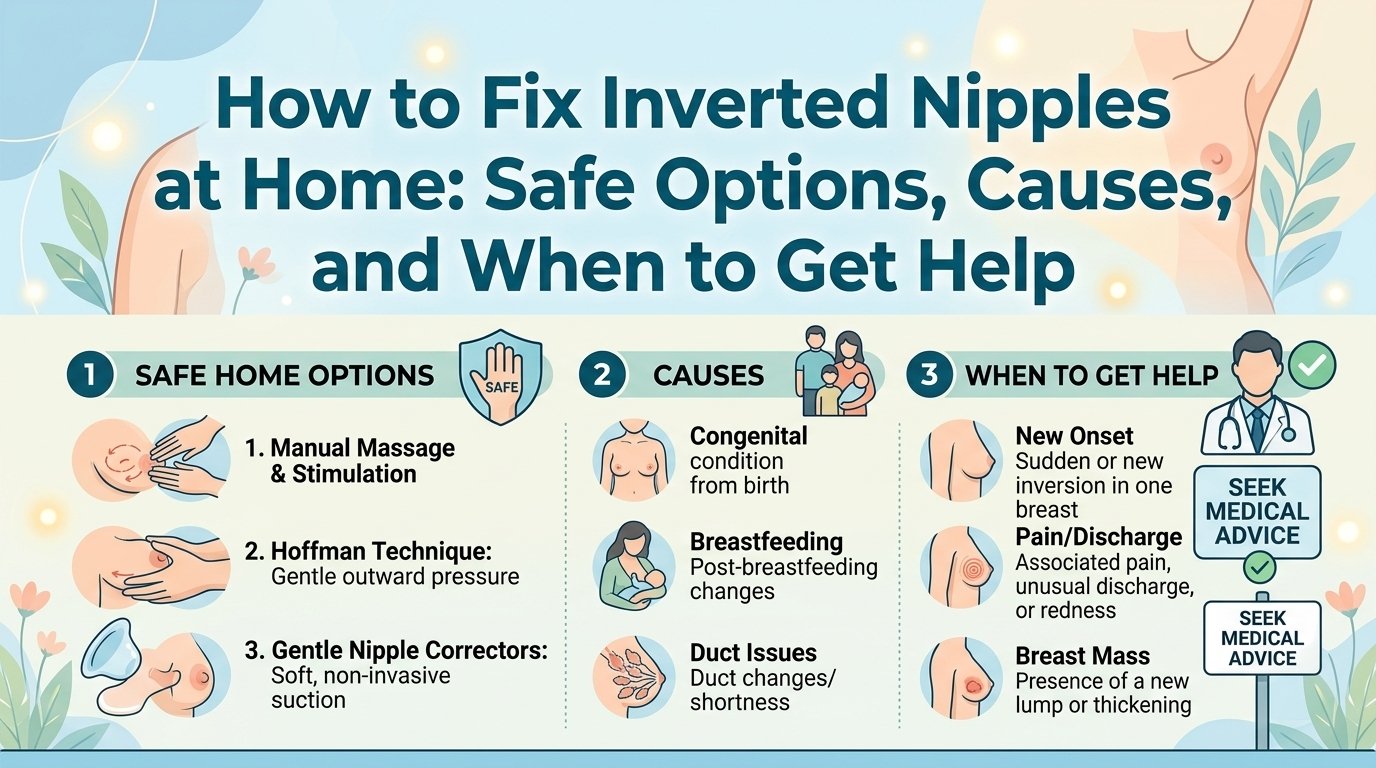
Inverted nipples are where the nipple, instead of protruding outwards, will either appear flat or turn inwards, into the breast. They have long been a natural characteristic of many people, existing since birth or when a person becomes an adolescent. Flattened and inverted nipples do not constitute the cause for a problem with this natural trait.
If you’re wondering how to fix inverted nipples at home, the answer depends largely on why the nipple is inverted and how easily it can be brought outward. A nipple may temporarily flatten from breast fullness, pregnancy, nursing, or hormonal fluctuations. Others may always invert as a result of natural pulling by the connective tissue or ducts that lie beneath the skin. Gentle touch, simple manual methods, or a suction device can help a person (primarily to facilitate breastfeeding) pull a nipple outward; this typically isn’t a permanent solution.
In some cases, of truly deeply inverted nipples, your physician can determine if medical or surgical interventions are necessary.
Last, but not least: Don’t try to home remedies for a nipple which recently turned inversion. Such changes can indicate infection, disease of the breast or, more rarely, even cancer.
What Are Inverted Nipples?
An inverted nipple sits inward rather than projecting above the surrounding areola. This is different from a flat nipple, which rests approximately level with the surrounding skin.
When learning how to fix inverted nipples at home, it is important to understand that nipple shape varies considerably between individuals. Some individuals are naturally blessed with erect nipples, while others may be born with either one or both nipple inverted or “flat”. According to Cleveland Clinic, flat and inverted nipple anatomy can be found in about 10% to 20% of the general population.
Like the inverted nipple itself, the inversion may be less or more severe; with some nipples being pulled outward with a little stimulation and drawn inward again; and others that can be pulled out manually but stay retracted, or that are so “stuck” they do not pull outward unless stimulated appropriately or aided with specific treatment.
It is important to make this difference because some methods which help an inverted nipple be fully inverted or everted may not work for one which has ducts that have shortened and tether the nipple, or scar tissue attached, making it tether the nipple inward.
Congenital vs. Newly Developed Inversion
One of the most useful questions is whether the nipple has always looked this way.
If you’re researching how to fix inverted nipples at home, it is important to consider whether the inversion is longstanding or a recent change.If you have had inverted nipples for as long as you can remember, it is most likely just a normal part of your anatomy. If one of your nipples has always been pointing out but recently started pointing in, it is worth getting checked out. A change in position or shape does not necessarily mean it is cancer. Infection, inflammation, scarring, aging breast tissue, pregnancies, and a number of other conditions that are not cancerous can lead to changes in your nipples so the cause needs to be ascertained for yourself and diagnosed.
Why Do Nipples Become Inverted?
Several factors can contribute to nipple inversion.
Natural Development
Flat Or Inverted Nipples The nipple can just be born with flat or inverted. Normally it just grows a little bit through the different developmental procedures of your breasts with the tubes and tissue actually pulling on that nipple and causing that. Flat are inverted nipples do not cause that the disease.
They don’t have a disease to be dealt with.
If they don’t look like them and they don’t cause any symptoms you have absolutely no medical reason to get them dealt with.
Pregnancy and Breastfeeding
If you’re researching how to fix inverted nipples at home, keep in mind that pregnancy can temporarily alter the appearance of the nipple and areola. Engorged breasts may also cause the nipple to flatten out or make it harder for an infant to latch onto. The nipple flattening that occurs as a consequence of the breasts becoming engorged eventually resolves as the inflammation passes. According to Cleveland Clinic, these structural inversions are more persistent. Often, addressing fuller breasts and improving the baby’s ability to latch successfully can be a more effective method of treating the condition than addressing the nipples themselves.
Previous Surgery or Injury
Surgery or trauma to the breast tissue below the nipple can cause damage to the nipple or make it unable to stick out properly because of scar tissue formation pulling it in. This kind of condition cannot be treated effectively by home remedies because the actual tissue itself has been altered.
Infection or Inflammation
Changes in the nipple can be associated with breast infections and conditions affecting the ducts. For instance with duct ectasia one can get inflammation with nipple inversion, formation of a lump in or behind the nipple, a painful breast, or nipple discharge. If the inversion occurs with a red, hot, painful breast with swell and discharge or with a raised temperature, home reduction is not the treatment of choice; instead one should seek medical advice.
Age-Related Changes
Breast tissue changes naturally over time. Changes in the milk ducts and surrounding tissue can sometimes cause nipples that were previously more prominent to become flatter or inverted.
A gradual change is not necessarily dangerous, but a noticeable new inversion should still be discussed with a healthcare professional.
Can You Correct Inverted Nipples at Home?
Temporary solutions When you try to evert an inverted nipple with home methods or by providing external stimuli the objective is usually an outward movement of the nipple and possibly the erection of it. Temporary solutions: Such a stimulation is usually the basis for manual massage to help prepare to evert the nipple as a mother prepares for breast feeding. They are not expected to produce a permanent modification of physical structures of the breast and are not always the most efficient method. You should think of the methods as having assisted the nipple in temporarily moving from inverted, not as having changed the underlying cause of the inversion.
Gentle Manual Stimulation
Nipples. As nipples do contain erecticle tissue, in fact. Light pressure may make it temporarily extend. To promote nipples to protrude in the correct direction try this: Place the index finger as well as finger around the nipple, roll it outward a bit Cleveland Clinic explain; an extra trigger may also briefly erectile your nipple (cold).
The key word is gentle.
There is no benefit to pulling forcefully, pinching aggressively, or repeatedly manipulating sensitive tissue until it becomes painful. Excessive pressure can cause irritation, swelling, or skin injury.
The Hoffman Technique
Hoffman technique to evert out a nipple The thumbs are gently placed on either side of the nipple and pulled apart. According to the Cleveland Clinic, this is a method that could coax a nipple outward and it’s particularly cited if the nipple needs to be everted out to begin breastfeeding. While it might provide gentle stretching of the tissue surrounding the nipple, it shouldn’t be relied upon as a permanent fix due to varying evidence and personal results. If you feel painful or discomfort performing this, discontinue.
Breast Pump or Suction
Sucking on your breast pump or another specific contraption created for correcting inverted nipples can suction out the nipple, pulling it forward. According to the Cleveland Clinic, it’s appropriate to use suction devices “to promote outward protusion of thenipple in cases of difficulties encountered during breast feeding.”2
Suction requires precaution, however. Too much suctioning on the nipple will result in skin injury including, but not limited to, swelling, bruising, skin damage, or pain. Be sure to adhere to instructions for the device being used and err on the side of lighter suction instead of the level you think will perform best. A lactation consultant can diagnose the actual need for a suction device if you plan on breastfeeding.
A Simple At-Home Approach for Mild Inversion
If your nipples have always been inverted and you have no concerning symptoms, a gentle approach may be reasonable.
Step 1: Understand Your Normal Anatomy
Look at both nipples and determine whether the inversion is longstanding. Notice whether one or both nipples are affected and whether they respond to gentle stimulation.
This information can help you understand whether you’re dealing with a stable anatomical variation or a recent change.
Step 2: Try Gentle Stimulation
With clean hands, gently stimulate the nipple or surrounding areola. Some nipples naturally project outward in response to touch or cold.
Do not squeeze aggressively.
Step 3: Consider Gentle Areolar Pressure
If appropriate, you can try a gentle technique such as the Hoffman maneuver. Apply light pressure around the nipple rather than forcefully pulling on it.
Stop if you experience pain.
Step 4: Evaluate the Result
If the nipple comes outward but retracts again after stimulation, that tells you something about the degree of inversion. Temporary eversion does not necessarily mean the underlying anatomy has been permanently corrected.
Step 5: Avoid Overdoing It
Repeated manipulation is unlikely to produce better results simply because you do it more often or with greater force. If home techniques are uncomfortable or ineffective, professional guidance is a better next step.

Inverted Nipples and Breastfeeding
An inverted nipple doesn’t mean that you are unable to breast-feed. With the baby using your nipple and then covering part of the areola, people with flat and inverted nipples are commonly able to breast-feed. Cleveland Clinic states that a better latch might sometimes improve feeding as then your baby needs to take the nipple along with part of the areola rather than sucking on only your nipple tip. If the baby is having trouble latching, consider asking an expert such as a lactation consultant for assistance rather than pulling the nipple out of the chest with your fingers.
Nipple Shields
A nipple shield is a silicone tool, although sometimes it can assist in latching to a short, flat, or inverted nipple. These devices are noted to be a short term option when dealing with a short, flat, or inverted nipple according to the Cleveland Clinic. Nipple shields don’t always work for every nursing circumstance and assistance is useful. A lactation consultant could also assess if child positioning and latched contributed to the problem.
Engorgement Can Make Inversion Look Worse
Breast fullness can flatten the nipple and make it harder for a baby to latch. In this situation, addressing the engorgement may improve nipple projection without trying to permanently correct the nipple itself.
What Not to Do
Searching for home remedies can lead to suggestions that are unnecessarily aggressive or unsupported. Protecting the delicate skin and tissue around the nipple should be the priority.
Avoid:
- Forcefully pulling the nipple outward
- Using excessive suction
- Repeatedly pinching the nipple
- Applying irritating household substances
- Using unregulated devices that cause pain
- Piercing the nipple specifically to correct inversion without medical advice
Nipple piercing is occasionally marketed to the masses as a way to force the invert to come to the outside of the skin, but as mentioned earlier it won’t always work and it certainly adds another layer of risk. Another option that was mentioned at Cleveland Clinic was that you should talk to your doctor if you think you may want to breastfeed because if that’s the case, a piercer should not pierce a nipple with an invert.
A procedure that involves bleeding, considerable pain, puffing up of the skin, or scarring is not to be regarded safer because it’s done at home by the home-body.
When Home Methods May Not Work
Sore spot Home treatments have come a long way, but they come with limitations in instances when inversion happens caused by modifications in nipple’s underlying structure For instance, injury or surgical procedure can cause a scar tissue or body inflammation which can actually tug the nipple, and hence inward in position. It might not be effective to simply attempt to push your nipple outward when that is an issue.
Some persistent as well as deep inversions also will not be impacted in spite of consistent physical manipulation. In cases which a persons look worries a doctor as well as non aggressive approaches to manipulate the nipple has been implemented, as well as proven inefficient for the inversion they will talk over which therapy alternatives are available based on the kind and severity of the inversion.
When Should You See a Doctor?
A recent nipple inversion should also be assessed if it only appears in one breast, or develops suddenly or without any identifiable cause.
Cleveland Clinic advises calling a doctor if a sudden onset nipple inversion is found, since it can, at rare times, be indicative of an underlying medical problem. The NHS advises paying attention to changes in nipple appearance and other breast symptoms, especially when nipple inversion is a change from your normal presentation.
Seek medical evaluation if inversion is accompanied by:
- A breast or armpit lump
- Nipple discharge, especially bloody discharge
- Persistent breast or nipple pain
- Redness or swelling
- Skin dimpling
- A rash or flaky nipple skin
- Changes in breast size or shape
- Fever or signs of infection
- A sudden change affecting one nipple
These symptoms do not automatically mean cancer. They simply mean that a proper assessment is warranted.
How Doctors Evaluate New Nipple Inversion
A health care professional may start with a physical exam of the breast and nipple. He or she might check for masses, tenderness, any changes in the skin of the nipple or surrounding breast tissue, any discharge, or anything else unusual.
Based on your age, symptoms, examination findings and health history additional tests may be needed to discover the reason for the nipple change. These may include mammography, breast ultrasound, breast MRI, or needle biopsy in certain cases.
These tests are not meant to assume that there is anything very serious happening, but they may help identify the cause of the change and detect an underlying breast health concern that requires treatment.
Medical Options for Persistent Inversion
If the inversion has been there a while and you’re looking to make a more permanent change, medically there are options.
Treatment will depend on the severity and cause. An abscess may need to be drained or antibiotics may be used if an infection is present. Any other causes of the inversioin must be treated first.
Plastic surgery can also help in creating a more projecting nipple for those desiring cosmetic correction. The procedure used will be dictated by anatomy, degree of inversion and importance of duct preservation.
This is especially important for people considering breastfeeding in the future. Talk about this goal with the surgeon beforehand, because certain corrective procedures may interfere with the milk ducts.
Can Inverted Nipples Become Normal Without Treatment?
A flat or temporarily inverted nipple might temporarily “flip out” when the associated cause resolves. The nipple can look flatter with the fullness that can result from swollen breasts and go back to being flat once the swelling reduces. Breastfeeding or hormone changes related to pregnancy can also affect nipple appearance.
A nipple that is inverted and always has been is probably unlikely to flip out on its own, although it is not an impossible scenario.
There’s also not really a need to “fix” a nipple just because it’s a different shape than your friends or partners’. Flat and inverted nipples may be entirely normal anatomically.
Final Takeaway
If you’re looking for how to fix inverted nipples at home, gentle approaches such as manual stimulation, the Hoffman technique, or carefully used suction may temporarily encourage the nipple to project outward. These techniques work particularly well if the concern is breastfeeding or minimal, pliable inversion. But in none of these cases is the anatomy expected to be permanently altered. Long term inverted nipples may well present no problems and may not need treatment at all.
A very different scenario is a nipple recently going into inversion for no discernible reason and if there is an associated lump or nipple discharge or pain or skin symptoms or any other concern at all about one’s breasts.
In such a situation a medical assessment must precede home methods. The gentle approach with tempered expectations and Medical review are safest.

FAQs About How to Fix Inverted Nipples at Home
Can inverted nipples be corrected naturally at home?
Some nipples can temporarily protrude with gentle stimulation, manual techniques, or a suction device. These approaches may be more useful for breastfeeding or temporary eversion than for permanently changing nipple shape. The underlying cause and degree of inversion matter.
Is it normal to have inverted nipples?
Yes. Some people are born with flat or inverted nipples, and this is usually a harmless variation in breast anatomy. If the nipples have always looked this way and there are no other concerning symptoms, treatment may not be necessary.
Can breastfeeding be possible with inverted nipples?
Yes. Inverted nipples do not automatically prevent breastfeeding. A baby typically needs to latch onto the areola rather than simply the nipple. A lactation consultant can help with positioning, latch, and options such as a temporary nipple shield when appropriate.
Can a breast pump help pull out an inverted nipple?
A breast pump or specialized suction device may temporarily draw the nipple outward. This can sometimes help with breastfeeding, but it does not necessarily provide a permanent correction. Use suction gently and follow the device instructions to avoid irritation or injury.
When should an inverted nipple be checked by a doctor?
A newly inverted nipple should be evaluated, particularly if the change affects only one breast or occurs along with a lump, nipple discharge, breast pain, skin changes, redness, swelling, or dimpling. Sudden nipple inversion can sometimes be associated with an underlying breast condition.
Can massage permanently fix inverted nipples?
Gentle stimulation may temporarily encourage the nipple to protrude, but massage cannot be relied upon as a permanent correction. Avoid forceful pulling, excessive pressure, or techniques that cause pain or damage to the surrounding tissue.
Conclusion
If you’re wondering how to fix inverted nipples at home, the right approach depends largely on why the nipple is inverted and whether it has always looked that way. Averted nipples are often not problematic and usually need no treatment. Gentle massage, manipulation, or even an appropriate suction device might only temporarily protrude the nipple (for example, in preparation for breastfeeding). Never pull sharply or over-aggressively and do not attempt techniques which may damage your nipple tissue-the result can be pain and soreness rather than better results.
Finally, see your doctor if the inversion is a new, sudden development, appears to have occurred unilaterally or is accompanied by a breast lump, discharge from the nipple, an abnormality of the skin of the breast, or discomfort and swelling of one breast.
If your breast inversion is affecting breastfeeding in an uncomfortable way, is so visually disfiguring as to cause distress or is simply visually unsatisfying to you, consult your doctor who will advise on appropriate and relatively safe treatments.