

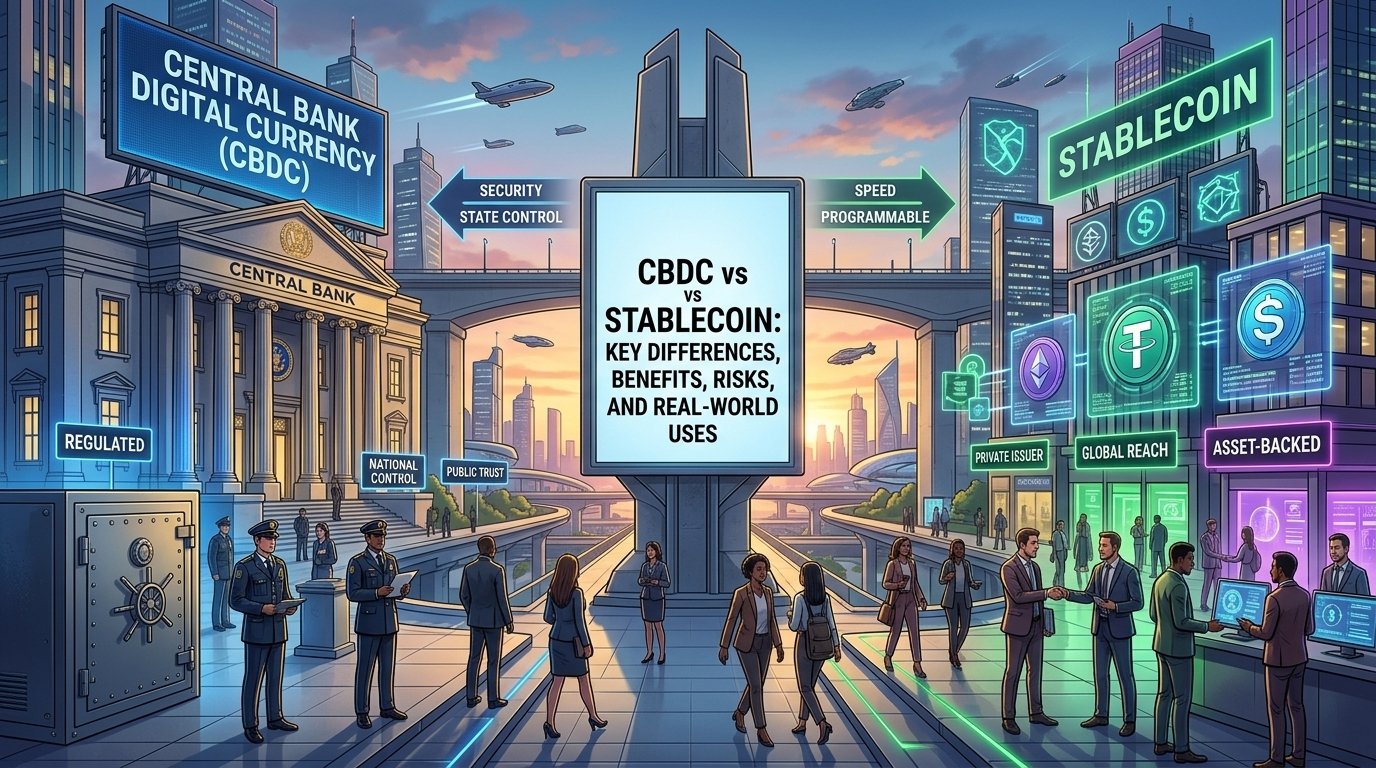
The debate around CBDC vs stablecoin is really a debate about two different approaches to digital money.Both could be able to transfer value electronically, allow for faster transactions and, may both operate with some kind of blockchain infrastructure or similar systems. However, some similarities are likely a trap. Unlike central bank digital currency (CBDC), which functions as public money that appears as a direct liability of a central bank; stablecoin is an asset-backed private digital token that attempts to maintain a relatively stable price by holding an equal amount of a specified asset.
This fundamental difference impacts nearly all the other characteristics including who will be the issuer of the money, how will it be supported by reserves, what will be the channels to access money, what risks individuals will bear and how regulators will frame and manage this matter.
However, stablecoin plays increasingly vital role in the crypto-trading sector, in decentralised finances (DEFI), in the field of cross border transfers, in the platform design that is integrated into the blockchain technology or any related services. CBDCs on the other hand are being discussed by many central banks as alternative digital form of the sovereign money for the use in retail settlements and wholesale.
According to Bank for International Settlements notes that the retail CBDCs is conceived as a digital form of a central bank money while stablecoins are privatized token value determined by the holder on redemption and stability are guaranteed not through holding central bank money in a fund, or through use in central bank operations. It determines on the holders redemption mechanism, reserve requirements, legal design as well as general market confidence.
What Is a CBDC?
A central bank digital currency ( CBDC) is the digital form of a country’s central bank money – its national unit of account. That isn’t intended to be a substitute, or alternative, for a country’s entire private money system. The F.R.D.
Has published research that outlines CBDC in part as a digital money that is denominated in the nation’s unit of account.
CBDC would be a direct liability of the central bank.”
There are two broad categories:
Retail CBDCs
What is the intended purpose and function of a retail CBDC? A retail CBDC is a means of payment for households and firms for common, every-day transactions; as an example for payments for purchases or for inter-firm transfers. 7 The ultimate design depends on jurisdiction. 8 Proposed architectures focus on various attributes like privacy-preservation, offline use, intermediary usage, limitations on holdings, and functional uses.
Wholesale CBDCs
Wholesale alternatives The wholesale version is geared at banks, interbank settling and is there to complement, not replace, cash at a consumer level.wholesale CBDCs offer a way for banks or institutions such as those in wholesale money markets tosettletheir trades. Where theBIS separates into retail CBDCs used for shopping around andwholesale CBDCs for settlements Between Institutions. CBDCs are issued by central bank, fundamentally differing from other types of tokenised digital asset issued by the likes of private firms.
What Is a Stablecoin?
A stablecoin is a privately issued digital token designed to maintain a relatively stable value relative to a fiat currency or reference asset or basket of assets. The reference is usually one sovereign currency, often one backed by significant global economic weight, the US dollar. Stablecoins can be backed by a reserve of physical assets, such as a collection of fiat cash, short-term government bonds, or various other types of commodity or financial assets, depending on the structure designed and managed by an issuer.
They are thought to take some characteristics of traditional currencies (one unit of accounting that maintains its value) together with aspects of blockchain technology that lend themselves to easier transmission, Programmability or both.
For instance, a token pegged to $1.00 US dollar will aim for that unit value. It is transmittable between a blockchain compatible wallet application, digital currency exchange, application, and any eligible public key or network identifier on a blockchain network. Stablecoins serve an important role in crypto markets, enabling stablecoin payments and settlement with relatively stable transaction value for exchanges and settlement processes, eliminating the need for conversion into traditional banking money on every trade.
They are also being considered seriously for their payment and cross- border applications. One paper by BIS published in 2026 discusses that these stablecoins have already become a constituent element in overall blockchain finance structure and may become intertwined with the process involving sophisticated, context specific, rules, for use by smart contracts.
CBDC vs Stablecoin: The Main Differences
The easiest way to understand the distinction is to compare the two according to their issuer, backing, legal structure, and intended use.
| Feature | CBDC | Stablecoin |
| Issuer | Central bank | Usually private company or financial institution |
| Type of money | Central bank money | Private digital asset |
| Liability of | Central bank | Stablecoin issuer or relevant legal structure |
| Value | Based on national currency | Usually linked to fiat currency or another reference asset |
| Blockchain required? | No | Often, but not necessarily in every design |
| Main purpose | Digital form of sovereign money | Digital representation of stable-value assets |
| Primary risks | Design, privacy, cybersecurity, financial-system effects | Reserve, redemption, issuer, liquidity, technology, and market risks |
| Monetary policy connection | Direct | Indirect |
| Typical crypto use | Depends on design | Extensive use in trading and DeFi |
The most important difference is who stands behind the digital money.
A CBDC is a claim on the central bank. A stablecoin generally represents a claim associated with a private issuer and its backing arrangements. That distinction creates different forms of trust and risk.
Why the Issuer Matters
One of the clearest differentiators between these digital-money arrangements lies in who, or what, issues the money: In a CBDC, the digital money is created by the central bank, meaning that the central bank assumes directly the liability of the currency. In a stablecoin, the digital currency is produced by a non-monetary authority, like a private company. The degree to which such an entity maintains the intended value is a question of its overall arrangement: Its reserves, redemption policies, legal framework, governance, and market confidence.
This doesnt automatically mean every stablecoin design is insecure: some structures may provide substantial reserves and sound governance mechanisms but the locus of reliance is different.
The BIS has highlighted that relies on reserve assets, redemption policies, the legal framework, and market confidence. That is why the name on a token and the stated peg do not tell you all of what you need to know.
How They Differ in Stability
Both systems could feature a stable unit of account – but it comes about via very different methods. The former would function as central bank money, and would thus have the inherent properties of central bank money – and since it’s a central bank digital currency, it would take a similar form to the fiat currency it is tied to the dollar-or equivalent. Meanwhile, in a typical stablecoin setup, value is preserved through reserves, redemption claims, marketplace mechanics or another stabilization feature.
As a result, there’s a key difference.
Should a stablecoin claim to track the US dollar, users will want a clear sense for why the token should be pegged at or close to the dollar, which may involve looking into the reserves and redemption process of its issuer. TheBIS itself cautions that stablecoins don’t by definition have same ‘convertibility at par’ features as central bank money in times of financial stress. In other words, “stable” is a goal, not an ironclad promise, of how the token will behave.
Blockchain and Programmability
So one of the drivers behind the success of stablecoins is their link to blockchain-based financial systems. A stablecoin can be incorporated into decentralized apps, smart contracts, decentralized exchanges, lending platforms etc. So, a smart contract can be coded such that it automatically sends stablecoins, once certain conditions are met.
It can therefore be an asset for automate financial transactions.
The BIS in a2026 research demonstrated how stablecoins can be more than just mere payments, where multiple transfers and other financial operations are grouped together. While CBDCs may also have digital and programmable features, they do not necessarily involve a public blockchain network. That is an important distinction. As digital money and money over blockchain do not simply coincide, a central bank can also create a digital currency on centralized as well as permissioned infrastructure.
Similarly, private digital asset arrangements may also deploy various forms of distributed technology.
What is thus really relevant is not just whether the system is based on the blockchain, but how it is designed, under whose governance is, and what type of claim does a user gain on the asset.
CBDC vs Stablecoin for Payments
Both models could support digital payments, but their strengths and limitations may differ.
A CBDC could serve as a digital form of central bank money for payments. Depending on its features, it could potentially be suitable for retail, person-to-person transactions, offline payments, and other purposes. Stablecoins could be useful where blockchain interoperability and programmable transactions are particularly relevant, such as in a business operating within a blockchain ecosystem, that needs to pay in stablecoins without shifting between a crypto network and traditional banks on every transaction.
They could also work as a tool for international payments in that blockchain payments might not have the same schedules as traditional payment systems.
The BIS also noted that even tokenised arrangements could play a role in speeding up and programing payments and facilitating atomicity – settling trades when transactions occurs – but also raised issues related to stablecoin convertibility and financial stability.
So the better question is not simply which system is faster.
It is faster for whom, for what transaction, under which regulatory structure, and with what level of risk?
Which Is More Private?
Privacy is one area where there is no universal answer.
CBDC design could cater to varying privacy requirements based on national law and technology. Design considerations may range from the reliance on intermediaries, tiered identity checks, or privacy features or restrictions on transaction amounts. Privacy may also vary for different types of stablecoins.
For example, most blockchain transactions (including stablecoin transfers) that are published and publicly verifiable to blockchain address and transaction history can be tied back to a person’s identity when combined with an off-chain persona or information.

The actual level of privacy and immutability depends on the technology. Given regulatory concerns of using public-permissionless blockchains in financial crimes, regulators have pointed to potential threats to financial integrity (as stressed in the BIS report on stablecoins) from the design of and use of stablecoins on these systems. In sum, financial sector regulation on privacy should be driven by an assessment of the underlying technology/system, not simply a categorization as either CBDC or stablecoin.
Financial Stability and Banking Risks
The broader financial system is another major difference.
Meanwhile, central banks must contemplate how the extensive adoption of a CBDC might impact commercial banks, deposit balances, credit creation, and overall financial stability. If customers could easily move large sums of money from deposits to CBDCs during times of panic,banks might experience an accelerated run-off of funding. Staff at the Federal Reserve have tried to understand these implications and the tools available to limit them.
The concerns regarding stablecoins are different.
Ifstablecoinissuersareholdingverylargescaleamounts of tradistonal financial assets on deposit then the massive growth or run off of these liabilities could give ruse to some market stress issues. TheBIS notes that if these stablecoin issuers use existing financial assets as collateral (or invest in suchassetsastreasurydepositoriesor similar) thenthe widespreaduse of stabelcoins couldwellharedisproportionateeffectsbontb bank lending and on bank funding depending on its construction, regulation and patt ern of use. These are the issuesthatinterest regulators to stabe coins even if currentlytheir dominant use is confined to crypto markets.
Advantages of CBDCs
CBDCs could offer several potential benefits.
Direct Connection to Central Bank Money
A CBDC would be a form of central bank liability rather than a privately issued token.
Digital Convenience
A properly designed system could make sovereign money available through digital payment infrastructure.
Potential for Faster Settlement
CBDCs could potentially support more efficient settlement, particularly in wholesale financial markets.
Monetary-System Integration
Because CBDCs are part of the central bank’s monetary framework, they can be designed alongside existing payment and financial systems.
Potential for Programmability
Digital infrastructure could allow conditional or automated payment functionality, depending on the system’s design.
These potential benefits do not mean CBDCs are automatically superior in every application. Their usefulness depends heavily on implementation, interoperability, privacy, accessibility, and regulatory design.
Advantages of Stablecoins
Stablecoins have developed a different set of strengths.
Blockchain Compatibility
They can operate directly within blockchain ecosystems.
DeFi Integration
Stablecoins are widely used as settlement and liquidity assets in decentralized finance.
Programmable Transactions
Smart contracts can incorporate stablecoins into automated financial arrangements.
Cross-Border Potential
Blockchain transfers can potentially reduce some traditional cross-border payment frictions.
Crypto-Market Liquidity
Stablecoins provide traders with a digital asset designed to have a relatively stable value, allowing them to move between volatile cryptoassets and a stable unit without leaving blockchain-based markets.
These features help explain why stablecoins have become a core part of crypto infrastructure. At the same time, the BIS warns that widespread stablecoin adoption could create financial and monetary risks depending on how these assets are used and regulated.
Common Misunderstandings About the Two
Several misconceptions can make discussions about digital money unnecessarily confusing.
“A CBDC Is Just Another Cryptocurrency”
Not necessarily.
A CBDC can use some of the same technological concepts as cryptocurrencies, but its monetary and legal structure is fundamentally different. It is issued by a central bank rather than created as a privately issued cryptoasset.
“Every Stablecoin Is Fully Safe Because It Is Backed”
Backing does not eliminate all risk.
Users still need to understand the quality and liquidity of reserves, redemption rights, issuer structure, custody arrangements, technology, and applicable regulation.
“Stablecoins and CBDCs Are Competitors in Every Situation”
Not necessarily.
They could compete in some payment applications while complementing one another in others. CBDCs, stablecoins, tokenized deposits, and other digital assets could coexist within the same broader financial ecosystem.
“Blockchain Automatically Makes Money Decentralized”
Technology does not determine the entire governance structure.
A token can use blockchain infrastructure while remaining controlled by a centralized issuer.
Which One Is Better?
There is no universal winner in the CBDC vs stablecoin debate because the two systems solve somewhat different problems.
A CBDC may be more appropriate when the priority is access to digital central bank money, sovereign currency settlement, or integration with a country’s official monetary system.
A stablecoin may be more useful when the priority is blockchain-native settlement, decentralized finance, programmable transactions, or moving value within digital-asset ecosystems.
For businesses, the choice may depend on factors such as:
- Target customers
- Geographic markets
- Regulatory requirements
- Blockchain compatibility
- Settlement speed
- Liquidity
- Privacy needs
- Custody arrangements
- Integration costs
- Counterparty exposure
The right choice therefore depends on the specific use case rather than on the label attached to the asset.
What Could the Future Look Like?
The future may not involve CBDCs replacing stablecoins or stablecoins replacing traditional money.
Instead, several forms of digital money may coexist.
The BIS has also elaborated significantly over time the concept of a tokenized financial infrastructure allowing various forms of money and assets to work together; an October 2026 paper suggests this sort of system will be able to manage tokenized wholesale CBDC reserves, commercial bank money, tokenized assets, all over common or interconnected infrastructures.
In this case, the various kinds of digital payment instruments could focus on their strengths, i.e., CBDC used as the pillar of sovereign digital currency; commercial deposits as the way to sustain credit intermediation; stablecoins used in blockchain-native markets and applications; finally, tokenized assets may have a direct interaction with one of the four previous kinds of digital payment instruments based on the designed programmable infrastructure. What the final framework looks like relies on the final choices which are to be made regarding regulation, technology, demand of public, commercial institutions and central bank actions and strategy.

Frequently Asked Questions
1.Is a CBDC the same as a stablecoin?
No. A CBDC is issued by a central bank and represents central bank money. A stablecoin is generally privately issued and attempts to maintain a stable value against a reference asset.
2.Are stablecoins safer than CBDCs?
Neither category is automatically safe in every respect. Stablecoins can face reserve, issuer, redemption, liquidity, and technology risks, while CBDCs involve questions about privacy, cybersecurity, financial stability, and system design.
3.Can CBDCs use blockchain?
Yes, a CBDC could potentially use distributed-ledger technology, but blockchain is not a requirement for creating a CBDC.
4.Why are stablecoins popular in crypto?
They provide a relatively stable digital asset that can be transferred and integrated into blockchain applications. They are widely used for trading, settlement, liquidity, and decentralized finance.
5.Can a stablecoin lose its peg?
Yes. A stablecoin can trade above or below its intended reference value. The likelihood and severity depend on its design, reserves, redemption mechanisms, liquidity, market conditions, and user confidence.
6.Will CBDCs replace stablecoins?
There is no certainty that they will. CBDCs and stablecoins could compete in some applications while serving different purposes in others.
7.Which is better for international payments?
It depends on the payment system, jurisdictions, regulatory requirements, liquidity, and infrastructure involved. Stablecoins may offer advantages within blockchain ecosystems, while CBDCs could provide direct access to central bank money where cross-border systems support them.
Conclusion
The key distinction in the CBDC vs stablecoin comparison is simple: a CBDC is digital central bank money, while a stablecoin is generally a privately issued digital token designed to maintain a stable value against a reference asset. That difference affects trust, regulation, risk, governance, and how each asset can be used.
In crypto markets, DeFi, programmable transactions, and possibly international remittances, use cases for stablecoins have been cultivated successfully. CBDCs are more being discussed as a way to translate national, sovereign money into a digital form, an infrastructure piece for new payment and settlement systems. No technology or concept is best suited for all use cases.
In all likelihood, the future won’t consist of one form of currency displacing another. Instead, CBDCs, regulated stablecoins, tokenized bank deposits and other digital tokens could coexist, performing specific, intended purposes. The more useful task for any user or enterprise, then, becomes evaluating individual forms of money based on such elements as issuer, legal standing, backing, technological framework, transparency/privacy of user operations and overall risks- rather than on whatever brand or label the item is given.











