

When you can hear scratching, scuttling, or chewing sounds coming from above your head, it is naturally uncomfortable, and especially so when they seem to occur through out the daytime. Most commonly, squirrels will find a home in your attic by entering it through small holes or tears in the roof, soffits, vents, or another weakened spot on your home. Squirrels in the attic can cause an array of problems, from destroying insulation, chewing wires, to contaminating the space with droppings and bedding down in the attic, in your home.
If you are trying to figure out how to get squirrels out of attic spaces, the most effective approach is not simply to chase the animal away. You want to find where it got in, make your attic less inviting, make the squirrel go away, and then seal the entry so it doesn’t come back. Time is important because you have squirrel babies in the attic, and sealing a squirrel nest in the attic can be a major problem.
The most humane solution really depends on the situation. If you have a lone squirrel at a point where you can easily seal it, you’re probably fine. However, if you have continuous activity, had to find it in the attic, or think you have young squirrels, professional removal might be required.
Why Squirrels Get Into Attics
Attics offer many resources a squirrel desires: protection from the elements, safety from predators, material to make a nest and somewhat consistent temperature. To a squirrel an opening through a roof or wall offers protected nesting sites.
Squirrels are excellent climbers and will use trees, power lines, house surfaces (like roofing and eave material) as climbing surfaces and access ramps to get to your home’s highest points. They may enter through broken soffits, roof vents, pipes passing through outer walls, loosely-mounted fascia and other gaps, through chimney surrounds or the openings in decaying roof/wall materials.
An opening needn’t appear large from ground level to attract the attention of a squirrel. Some may be subtly placed in conjunction with decorative or structural trim.
Once an entry into the home has been identified by an animal, they are likely to continue using it whenever they deem it appropriate and secure. If the activity in the attic remains peaceful it may soon become the preferred denning site for the animal.
Removing individual squirrels, without sealing the opening, proves useless because yet another of its kind may sooner or later discover the entry point again.
How to Tell if Squirrels Are in the Attic
The clearest indication is noise. Squirrels are most active during the daytime, so any evidence of skittering, running or gnawing and any moving above you during the daytime is an indicator that an animal is likely in the attic.
Other signs may include:
- Droppings or urine-stained areas
- Torn or disturbed insulation
- Nesting material gathered in one location
- Chewed wood or other materials
- Gnaw marks around an entry point
- Damaged vents or soffits
- Daylight visible through an exterior opening
- A noticeable animal odor in heavily used areas
Noise alone isn’t the only clue that there’s a squirrel in the attic. Raccoons, bats, birds, other rodents or wildlife may use the attic as shelter, so other information may be needed.
Activity patterns may provide a valuable tip-off. Daytime activity is normal for a squirrel, whereas all noise is nighttime based may indicate another animal.
If at all possible, determine the point of entry to the exterior of the attic before any action is taken, as identifying wildlife entry points can help guide a safer exclusion plan. Look at the soffit, fascia, roof lines, vents, or nearby trees for gaps in areas from a safe distance on the ground (Do not venture onto a roof to examine possible wildlife openings).
Find the Entry Point Before Removing the Animal
Locating the squirrel entry is one of the more crucial components of the removal process.
Conduct a perimeter inspection of the outside of your home looking for signs of compromise or entry. Of most concern are locations where your roof structure attaches to vertical walls, chimneys, ventilation structures, and fascias. Also pay attention to any location where the limbs of a nearby tree, brush, or shrub contact the house.
Scan for indicators like fresh gnawing, displaced materials, fur caught in the void, or scuff marks and soiling around a much-used entrance aperture.
If you find more than one access location, you need to establish which entry the squirrel is using, rather than immediately patching every aperture in your home. An attic-occupant likely has one primary entry location, as well as many lesser secondary accesses.
The outside surface nearest the suspected breach, using a remote triggering outside camera if accessible, can assist you without having to go right near the animal you’ve come to remove and especially helpful where a proper sight line to a potential hole is not practical.
Never go into a confined, precarious attic, only to discover an animal is inside. The space likely contains electrical hazards, exposed nails, insulation, structural instability, and several different types of things apart from the creature itself.
How to Get Squirrels Out of Attic Spaces
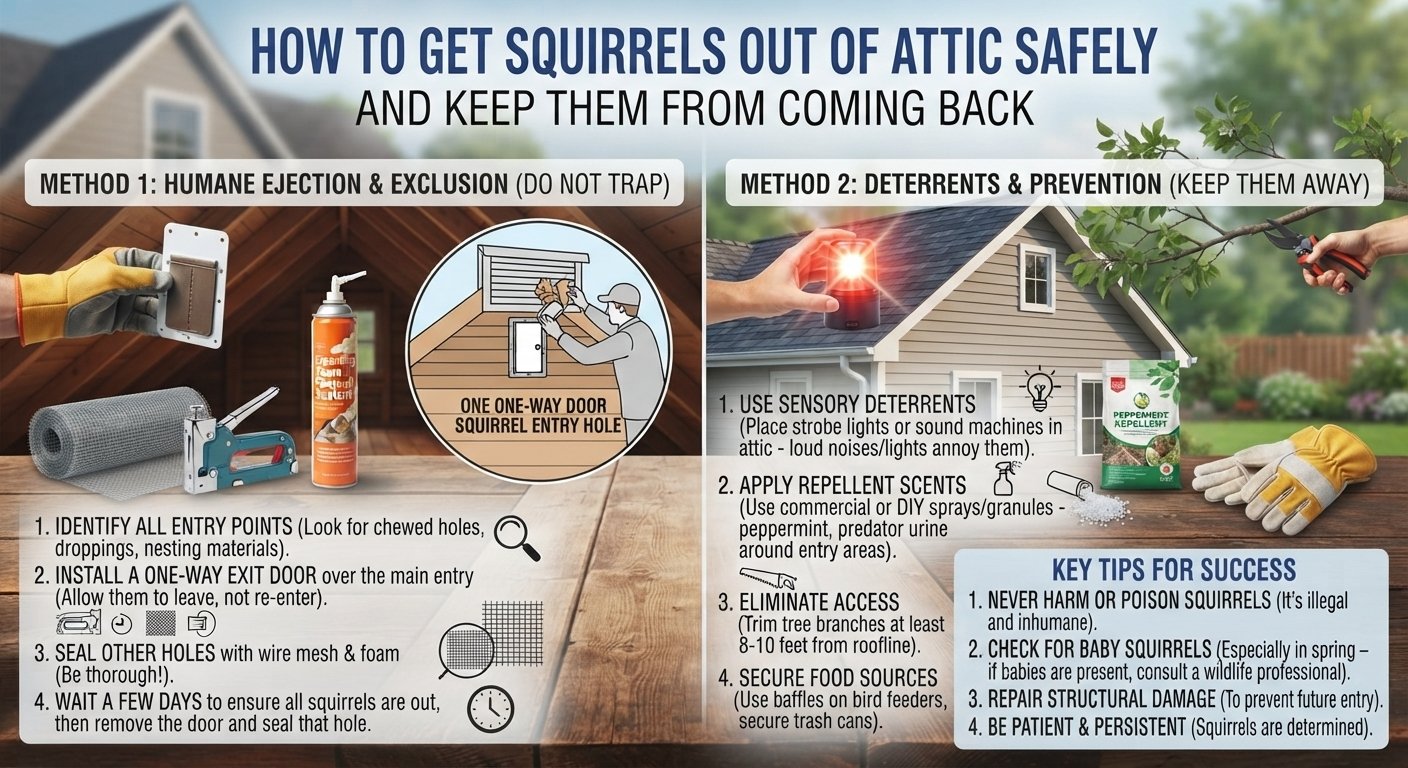
The core of any humane removal method is exclusion: encouraging the animal to leave and keeping it from re-entering.
If you’ve determined which of your points of entry is actually used by the squirrel, it is usually best to put up a properly installed one-way exclusion device that will permit the squirrel to escape while still preventing it from entering. An improperly installed one-way door or other exclusion device is one that may effectively trap the animal inside the building, which results in more damage, nesting and frustration.
Timing is extremely important. Make your best attempt to ascertain if infant squirrels occupy any of the nestings before attempting to exclude the adult. A female may briefly venture outside the attic to seek food and may be trapped out of the building after she has entered.
Baby squirrels will become desperate, vocal and odiferous if they are kept separate from their mother due to a closed-up exclusion opening, creating an even more complex and time-consuming removal problem than you would have had before or in the future. If there is even the slightest possibility that the nesting may contain infant squirrels, postpone your humane removal attempt and call for professional animal control help who will be well-equipped for any such removal task.
Make the attic less comfortable
Once it is clear that the animal will be able to leave in safety, you will also want to encourage it to leave and remove its attractiveness. Areas near the nesting sites may be indirectly attracted to or influenced by bright light and intermittent human traffic can make an area appear less secluded if once an attic was quiet. You may be able to take advantage of mild deterrents by skilled professionals who may use and appropriate one as part of their exclusion plan.
Never use harsh chemical repellents, mothballs or dangerous chemicals not designed for wildlife exclusion; not designed products can impact the health of humans and pets in and near your home or business.
Never use pesticides, poisons or toxins; The outcome should be the discouragement of the animals from that habitat and not the death or harm of an animal or injury to human or pet.
How to Use a One-Way Exclusion Device
The goal of a one-way door is just that-getting it out without it getting back in.
Place this over the active entry site once the animal is known to be out, or you’ve been sure it won’t trap the animal with babies. It will exit through it, but it won’t re-enter it.
Make sure this device covers your opening closely; a gap at the sides and there will just come back around it.
Watch that the creature remains gone-once you know it’s gone and there aren’t babies to raise within, you can seal the opening.
Be aware that there is an order in which to do this. Do not seal the entrance from the attic until you have knowledge that there is no animal present within.
This is the point in which an uncertain “is it gone?” situation makes it significantly safer to employ a wildlife exclusion professional.
What If There Are Baby Squirrels?
Baby squirrels make the scenario different, quite radically. The mother can abandon the nest for periods of time to feed and if you block the entry while that’s happening, you could seal up babies in the attic. To identify a nest you would see concentrated area of disturbance to insulation, shredded nest material and a source of constant noise and squirrels from one area.
The important thing to do if you suspect babies is NOT just to seal and sit and wait; instead the most reasonable solution is for someone with experience and proper humane procedures for squirrel exclusion to come out and check the situation.
If there are babies inside, the professional can implement a method for removing them, rather than separating the family. This is also why simply trapping adult squirrels can backfire-if the squirrel is a nursing female, trapping it without considering her family in the nest will only produce a new wildlife and waste problem in the attic.
Removing Squirrels Without Making the Problem Worse
You may consider using loud noises, chemicals or try to confront the squirrel directly to resolve an attic wildlife problem. Often, this backfires.
Scared squirrels are more likely to escape further into the attic, hunker down behind insulation and look for an exit through the building’s interior. As a trapped animal, it is likely to become aggressive.
Never try to catch a squirrel using your bare hands. Squirrels will bite or scratch if threatened, and you do not need direct contact to resolve the issue.
Poison should never be used on squirrels inside an attic. A poisoned squirrel may end up dying in an unreachable section of wall or attic cavity, creating ongoing foul odors and a difficult cleanup issue. It also unnecessarily puts your pets and other animals in danger.
Glue traps also are not suitable for squirrels. Their design is intended for smaller animals, and their use against squirrels can result in significant pain and injuries.
Controlled exclusion is always the better solution over animal confrontatio.
Repair the Damage After the Squirrel Leaves
Letting the squirrel go outdoors is the first part-the second is securing the building to prevent reentry. After removing the squirrel from the building, be sure to investigate around the existing opening to find possible damage the squirrel caused which would let it return. Squirrels will often chew at roof material, shingles, wood under the overhang, vents, or other possible weak spots in a structure.
At the point of damage, if the structure is weakened and cannot be secured as is without structural damage, replacing the damaged material or securing it at this point with some suitable construction material should be undertaken.
A patch is not the right way to deal with damage when the existing structure is weakened already. Look particularly at your attic vents, as damaged vents can permit animals to get inside an building. The ventilation system in an building is there in order to let moist air out of the structure while animals, which desire dark, warm spaces where they can breed young ones, will have a difficult time entering; a blocked vent has drawbacks. While working above is best left to professionals that can do it without hurting themselves, look for holes, structural weakness, and damaged material to repair/reinforce around old entry locations.
Do not plug up all of your attic vents though because these serve an actual purpose.
Check for Damage Inside the Attic
Squirrels can cause more than noise.
It may chew into wooden objects or materials in the attic. They can also destroy insulation as they make their homes. If their numbers had been there for some time check for evidence of damage to walls and contamination.
Electrical wiring may be gnawed at and, because some wild animals like rodents may chew off insulating covering of wires, electrical wiring can cause fire hazards if exposed and stripped. Call an electrician for expert service with damaged or suspect electrical wiring – it is ill-advised and dangerous for the consumer to effect a fix alone.
Signs of substantial colonies are highly concentrated droppings, signs of urinecontamination, and the existence of nest building materials. Use protective gear while cleaning contaminants and be careful not to agitate any dried droppings or waste into an aerosol for health reasons.
A professional cleanup of attic contamination due to a serious infestation or nesting, structural repair due to animals eating through them or any necessary wildlife removal might have to occur to make your attic safe and functional again.
Common Mistakes Homeowners Make
Perhaps the most prevalent mistake is to block off a hole as soon as you can hear activity. The animal may still be present or it may have babies depending on the mother.
A second common error is to repair only the most apparent hole. Squirrels frequently have more than one access to an attic, thus the repair must cover a broader area than where the damage first occurred.
Many homeowners get so caught up with dealing with the nuisance that they do not consider trimming back the access routes. Branches overhanging the house provide perfect pathways for animals to access the roof and they should be taken back a bit. Appropriate setback to reduce the potential for a nuisance to easily reach areas that have been damaged.
A poor long term solution for people is to try to use strong odors to deter critters for good. While a repellent can be somewhat effective, it cannot substitute the effectiveness of removing access areas.
In the end people may underestimate the inherent difficulty of working in a dirty, cramped attic space. Climbing to a roof can easily cause death or injury if the footing is not adequate, and attic working should be done by trained professionals that have no reason to increase the risks unnecessarily.
When Professional Wildlife Removal Makes Sense
Some situations are better handled by a wildlife-control professional from the beginning.
Consider professional help if:
- You suspect baby squirrels are present.
- The animal cannot be safely accessed or monitored.
- There are multiple entry points.
- The squirrel repeatedly returns after exclusion.
- The animal is trapped inside a wall or inaccessible area.
- You find significant wiring or structural damage.
- The attic contains substantial contamination.
- The entry point is on a steep or difficult-to-access roof.
- You are unsure which animal is making the noise.
An expert in this field is able to investigate the building, identify where the animals are getting in, determine whether dependent young are present, and recommend appropriate professional wildlife removal options.When hiring a professional ask them how they will stop reentry and what their policy will be if there are animals dependent on the animal they remove. The strategy for the removal should take the root cause of the access into consideration instead of relocating one animal and leaving the building open for others to enter.
How to Prevent Squirrels From Returning
After an animal has been removed and the areas repaired, prevention gets a lot more simple.
Periodically check the roofline on the building for holes or damaged vents and flashing, fascia, soffits, and cracks around utility entries as part of regular home maintenance tips. Any small structural imperfection on the building can become a point of entry to animals.
Trim tree limbs that reach toward the building away from roof and outside of structure when possible and reasonable. This will make it more difficult for squirrels in trees to be able to hop onto houses or into eaves.
Do not place easily available sources of food directly next to a building. While bird feeders themselves are unlikely to lead animals directly to a house, some feeding of birds can be one that will invite them toward the structure of your building, it may be difficult to avoid at all times.
Check and maintaining the entire exterior of your building is also important. Take care of deteriorated roofing, damaged trim and the condition of exterior wood.
It’s best to try and prevent pests through a combined approach of maintenance and exclusion. A few deterrents won’t prevent animals from getting in if the entire area around their entry point is readily accessible.
A Simple Squirrel-Removal Checklist
If you discover signs of squirrels in your attic, work through the problem in this order:
- Confirm the likely animal. Use the timing and type of noise as clues, but do not assume.
- Inspect exterior access points. Look at the roofline, soffits, vents, fascia, and nearby branches.
- Determine whether the opening is active. Watch from a safe location if possible.
- Consider the possibility of young squirrels. Do not seal an active opening without addressing this concern.
- Plan an exclusion method. A properly installed one-way device may allow the animal to leave without returning.
- Monitor the attic and exterior. Make sure the animal has actually left.
- Permanently repair the entrance. Reinforce damaged areas so another squirrel cannot reopen them.
- Inspect for damage. Check insulation, wood, wiring, vents, and contamination.
- Clean affected areas appropriately. Use protective measures and professional cleanup when needed.
- Reduce future access. Maintain the roof, soffits, vents, and nearby vegetation.
The most important step is not speed. It is making sure the animal is out before the opening is permanently closed.
Final Takeaway
Learning how to get squirrels out of attic spaces safely requires more than simply chasing the animal away. Determine potential entry and assess if a nest is located in the attic and if babies will present. Humane removal of the animal is then performed when it is safely possible. Once the attic is empty the hole is repaired and secured, damaged structures searched for, and contaminants/wires dealt with.
Poisoning, glue traps, sharp confrontations and early closing off of an entrance are to be avoided.
If the animal is in an inaccessible place, there are babies present, and damage is extensive, the aid of an animal management professional is appropriate. Successful remediation removes current problems and the entry method.
Frequently Asked Questions
1.How do I know if squirrels are in my attic?
Common signs include scratching or scampering sounds during the day, disturbed insulation, nesting material, droppings, gnaw marks, and visible damage around roof vents, soffits, or fascia. Daytime activity can help distinguish squirrels from some other attic animals.
2.What is the safest way to remove squirrels from an attic?
Humane exclusion is generally the preferred approach. Identify the active entrance, make sure no young squirrels are trapped inside, and use an appropriate one-way exclusion device when suitable. Once the attic is confirmed empty, permanently repair the opening.
3.Can I just seal the hole where the squirrel is entering?
Do not immediately seal an active entrance. A squirrel may still be inside, or a mother may have dependent young in a nest. Closing the opening too soon can trap animals inside or separate a mother from her babies.
4.How can I tell if a squirrel has left the attic?
Monitor the suspected entrance for activity and listen for continued movement inside. A properly installed one-way exclusion device can help establish whether the animal is leaving. The area should be monitored before the opening is permanently repaired.
5.What should I do if there are baby squirrels in the attic?
Avoid sealing the entrance or removing the mother without addressing the nest. Young squirrels may depend on the adult for care. A qualified wildlife professional can determine the safest way to handle the family and complete the exclusion.
6.Will squirrels come back after being removed?
They can return if the original entry point remains accessible. Repair damaged roofing, soffits, vents, or fascia after confirming the attic is empty. Maintaining the exterior and reducing easy access routes can also help prevent another squirrel from getting inside.
7.Can I use poison to get rid of squirrels in my attic?
Poison is not a good solution for attic squirrels. A poisoned animal may die in an inaccessible area, creating odor and sanitation problems. Humane exclusion and physical repairs are generally safer and more effective long-term approaches.
8.When should I call a wildlife removal professional?
Professional help is appropriate if you suspect babies are present, cannot safely access the entry point, hear animals trapped inside walls, find significant damage, or cannot determine how the animals are entering. Roof and attic work can also present safety hazards.
Conclusion
Knowing how to get squirrels out of attic spaces safely starts with identifying the entry point and determining whether the animal has a nest or young inside. Instead of closing up the entry point right away, employ humane exclusion techniques that enable the squirrel to exit the space without coming back. Once you are certain the squirrel has left the attic, patch any damaged roofing materials, vents, soffits or other points of entry to prevent future access. Inspecting for damaged insulation, wires or droppings after the removal is also a good idea.
Don’t put animals or your family members at risk with methods like poison, glue traps or directly interacting with the creature.
If you detect young or if the animal is physically located in an inaccessible or risky area of your property, calling professional wildlife removal can help you avoid further harm or an inefficient and likely futile do-it-yourself project.











