

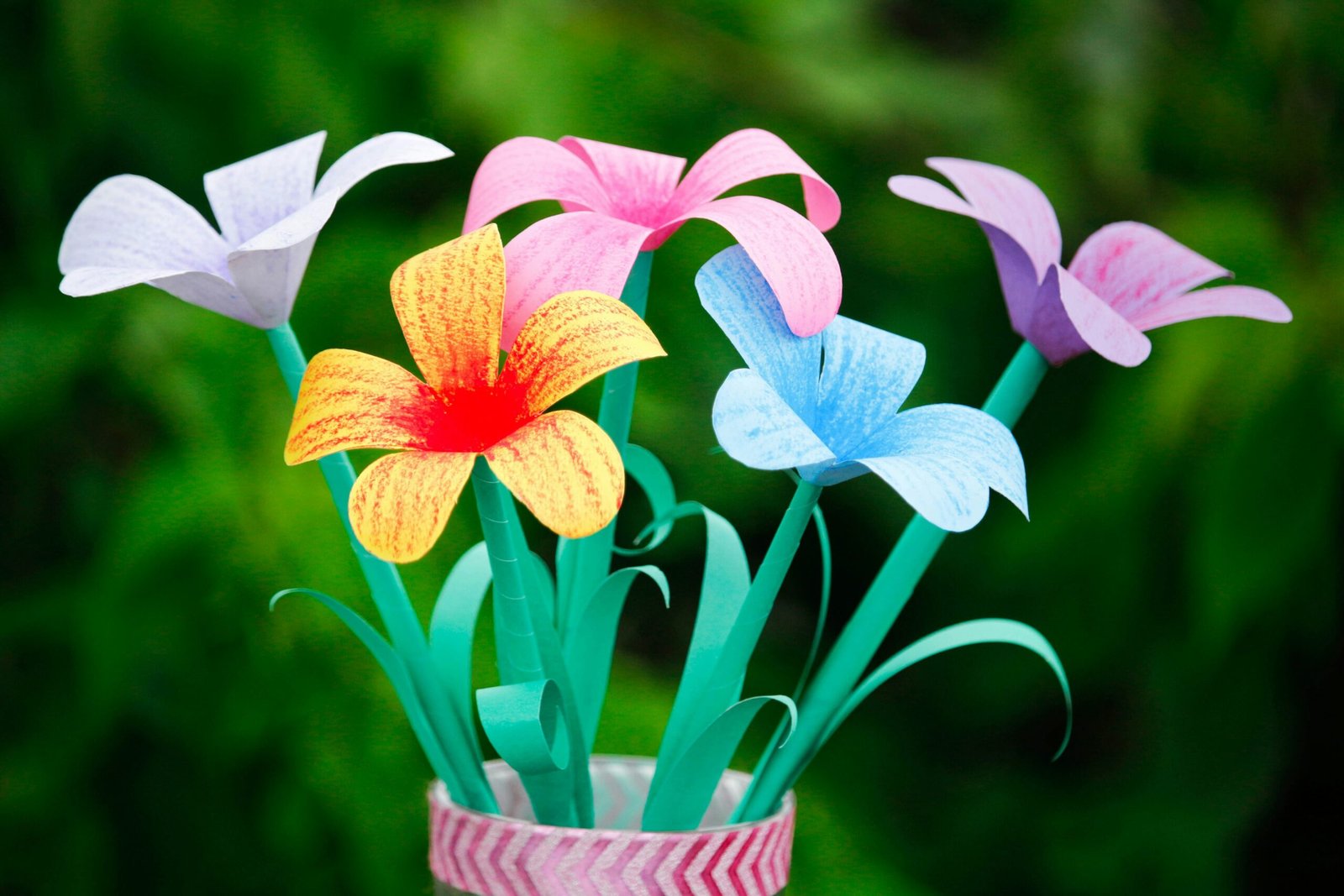
Pipe cleaner flowers is one of those crafts that is nearly foolproof for almost everyone: young kids, classroom groups, last-minute gift makers and even crafters who are seeking home decor-worthy flowers.They’re colorful, long-lasting, and require very few supplies. If you’ve been searching for how to make a flower out of pipe cleaners,You would hopefully like concrete, repeatable steps that yield recognizable flowers-not nonspecific, wonky blobs.
6 flower patterns (from super simple to more detailed) to choose from Supplies numbers so you can plan a bouquet of all the flowers Stem-reinforcement tips Troubleshooting for common issues Ways to display and gift your work How to tweak these flowers for varying ages and skills My tricks for making the flowers seem fuller and more realistic.
Quick Answer: How to Make a Flower Out of Pipe Cleaners (Basic Method)
If you just want the core idea:
- Choose 1–2 colors for petals and green for the stem and leaves; gather scissors or wire cutters and optional hot glue.
- Form petals by looping a pipe cleaner around a pen or folding and bundling pieces; twist ends to secure.
- Attach a green pipe cleaner as the stem by twisting it through the center; add leaves by folding and twisting green pieces onto the stem.
- Shape petals and center by curling, coiling, or fluffing; repeat to make multiple flowers for a bouquet.
This straightforward approach forms the basis for almost all pipe cleaner flower projects. Further down the page, you’ll find six step-by-step tutorials for particular types of flowers, along with advice for creating stems that won’t bend when you put your flowers in a vase.
Supplies You’ll Need (And How Many for a Bouquet)
If you’re learning how to make a flower out of pipe cleaners, having the right supplies—and enough of them—makes the process smoother, especially if you’re making a bouquet or leading a group craft.
Core Supplies
- Colored pipe cleaners including green ones for stems and leaves. Regular length will do for most projects; thicker “chenille” stems make a fuller look.
Scissors or wire cutters. Wire cutters for glitter pipe cleaners or thicker pipe cleaners may have blunt ends and make them harder to cut with scissors.
Additional tools: hot glue gun and hot glue sticks, floral wire, ruler, pen or pencil for looping petals.
Optional Embellishments
- Small pots, beads, buttons, glitter, ribbon, sand or Styrofoam (for arrangements).
Tissue paper if you plan to experiment with mixed-media blooms (see details below).
How Many Pipe Cleaners per Flower?
- Depending on your pattern, the counts might be different, but they are a good starting point:
Basic generic flower: 2-3 pipe cleaners (1-2 for petals, 1 green for stem).
Daisy/sunflower: 3-5 pipe cleaners (petals, center, stem, leaf).
Spiral rose: about 2-3 pipe cleaners.
Daffodils/tulips- approximately 4-6 pipe cleaners (petal, center, stem, leaf) You will need to cut the pipe cleaners in the following sizes: Hope this helps!
Bouquet Planning
For a 10-flower mixed bouquet, you might plan something like:
- 4 simple flowers (8–12 pipe cleaners total)
- 3 daisies/sunflowers (9–15 pipe cleaners)
- 3 tulips or daffodils (12–18 pipe cleaners)
- Plus extra green for leaves and stem reinforcement.
Having a rough count prevents mid-project trips to the craft store and helps you budget.
Table 1: Pipe Cleaner Counts by Flower Type
| Flower Type | Petal Pipe Cleaners | Center Pipe Cleaners | Stem + Leaf Pipe Cleaners | Total per Flower | Notes |
| Simple generic | 1–2 | 0–1 | 1 | 2–3 | Best for young kids |
| Daisy/Sunflower | 2–3 | 1 | 1–2 | 3–5 | Flat, multi-petal bloom |
| Spiral Rose | 1–2 | 0 | 1 | 2–3 | Classic rolled look |
| Tulip | 3–4 (cut pieces) | 0 | 1–2 | 4–6 | Bud or open style |
| Daffodil | 3 | 1 | 1–2 | 5–6 | Trumpet center |
| Grape Hyacinth | 1–2 | 0 | 1 | 2–3 | Clustered bloom |
Step-by-Step Tutorials: 6 Flower Patterns
These six patterns cover a range of difficulty and styles. You can mix and match them in a single bouquet for variety.
1. Simple Generic Flower (Best for Young Kids)
This is the easiest pattern and a great starting point for children or quick group crafts.
Supplies:
- 1 pipe cleaner for petals (any color)
- 1 green pipe cleaner for stem
- Optional: extra green for leaf
Steps:
- Loop the petal pipe cleaner around a pen or pencil to form 4–6 loops.
- Slide the loops off and pinch the center to create a flower shape.
- Twist the green stem pipe cleaner through the center and secure by twisting.
- Shape petals by gently pulling and curling.
- Add a leaf by folding a small piece of green pipe cleaner and twisting it onto the stem.
Shaping tips:
Use different size loops for different shapes, or curl ends for a softer feeling.
Common issues & fixes:
If the stem is loose, twist in the second pipe cleaner or a piece of wire in the green pipe cleaner.
2. Daisy / Sunflower (Flat, Multi-Petal Bloom)
This pattern creates a flat, cheerful bloom that works well in bouquets and wreaths.
Supplies:
- 1–2 pipe cleaners for petals (yellow, white, or mixed)
- 1 contrasting color for center (brown, orange, or dark yellow)
- 1 green for stem, optional extra for leaf
- Optional: floral wire for sturdier stem
Steps:
- Create a star-shaped petal base by looping a pipe cleaner into 6–8 loops and twisting at the center.
- Coil a second pipe cleaner into a tight disk for the center.
- Attach the green stem by twisting it through the center and securing.
- Glue or twist the center disk onto the petal base.
- Add a leaf and shape petals by curling tips outward.
Shaping tips:
Sunflowers should have yellow petals with a brown center. Daisies should have white petals with a yellow center. Fluff up the center to get a fuller appearance.
Common issues & fixes:
Create closeness if there are gaps between flower petals by adding some small filler loops. To stop center moving, secure with one more twist or small dot of hot glue.
3. Spiral Rose (Classic “Rolled” Look)
This rose uses a simple spiral technique to create a classic, recognizable bloom.
Supplies:
- 1–2 pipe cleaners for petals (red, pink, peach, etc.)
- 1 green for stem, optional extra for leaf
Steps:
- Fold a petal pipe cleaner in half and begin rolling from the folded end to form a tight spiral.
- Twist the loose end around the base to hold it firmly in place.
- Attach the green stem by twisting it through the base of the rose.
- Add a leaf and adjust the outer layers by gently pulling to open the rose.
Shaping tips:
A Tighter Roll = Smaller Rose. A Looser Roll = Bigger Bloom. Gently peel off outer layers for a more open look.
Common issues & fixes:
Should the rose become loose, roll the tip up tightly or adhere a small glue dot. If the rosestem feels loose, wrap a scrap of green around the join.
4. Tulip (Bud and Open Styles)
Tulips require a bit more cutting and bundling but produce a very recognizable shape.
Supplies:
- 5 petal pieces (same color, cut from 2–3 pipe cleaners)
- 1 green for stem, optional extra for leaf
Steps:
- Cut petal pieces to equal lengths (about 2–3 inches each).
- Bundle the petal pieces together and wrap the green stem pipe cleaner tightly around the base.
- Shape petals into a closed bud by keeping them aligned, or curl them outward for an open tulip.
- Add a leaf by folding and twisting a small green piece onto the stem.
Shaping tips:
PICK OFF pedals that align at bottom to create a tidy bud, or gently pull apart and curl petals to open flower.
Common issues & fixes:
Rewrap if petals are breaking apart. Tightly around base if petals spread apart If a little of the green stem is showing between the petals, add a small wrap around the base.
5. Daffodil (Trumpet Center)
Daffodils have a distinctive trumpet center that sets them apart from other flowers.
Supplies:
- 3 yellow pipe cleaners for petals
- 1 orange or yellow for center cup
- 1 green for stem, optional leaf
Steps:
- Roll three petal loops and twist at the center.
- Coil the center pipe cleaner into a small “cup” and secure.
- Attach the green stem through the center and twist to secure.
- Arrange petals around the trumpet center and add a leaf.
Shaping tips:
Center cup should be kept neat and close to center- curve petals very back to give the natural shape of a daffodil.
Common issues & fixes:
Center cup is too loose: re-coil it tighter. Petals are uneven: stretch or shrink the loops to equalize before connecting the stem.
6. Grape Hyacinth (Clustered Bloom)
This pattern creates a small, clustered bloom that looks great in pots and mixed arrangements.
Supplies:
- 1–2 purple or blue pipe cleaners for bloom
- 1 green for stem, optional leaf
Steps:
- Coil the purple pipe cleaner around a needle or pencil to form a tight cluster.
- Attach the green stem by twisting it through the base of the cluster.
- Add a leaf and trim any sharp ends.
Shaping tips:
Alternate coil tightness to suit the bloom density; trim the end to give a neat finish.
Common issues & fixes:
For clusters that are too open up, re-coil the wire tighter. Tuck or cut pointed ends of wire, if you have any.
How to Make Stems Strong Enough for Vases and Arrangements
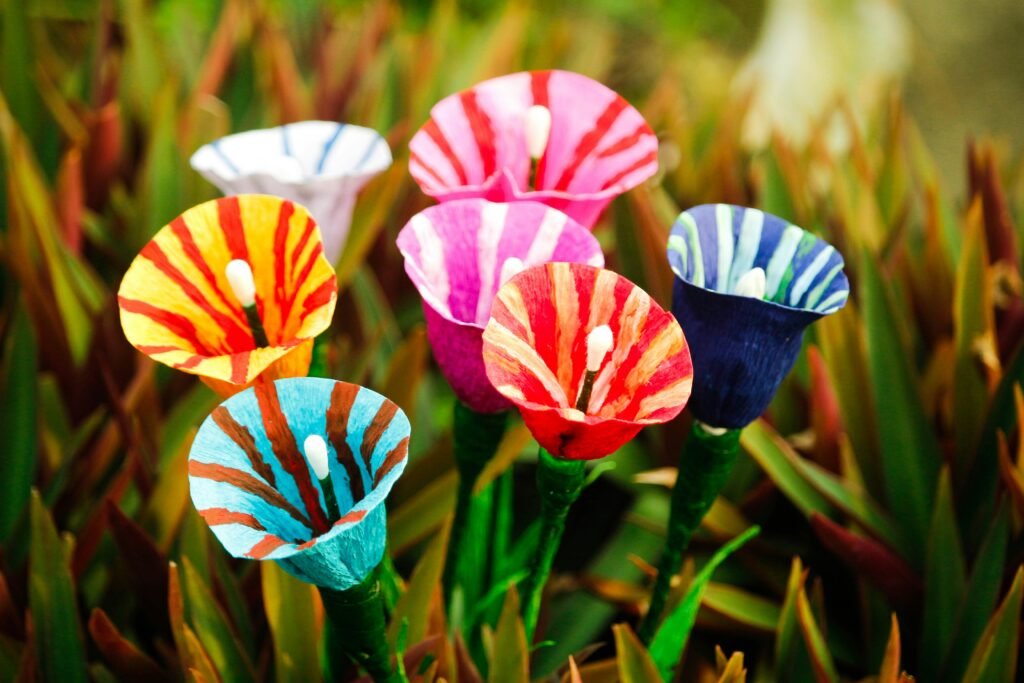
If you’re learning how to make a flower out of pipe cleaners, one common weakness in many tutorials is flimsy stems. If you want your flowers to stand in a vase or be handled frequently, reinforce the stems.
When to Use Floral Wire
If you’re learning how to make a flower out of pipe cleaners, use floral wire for bouquets that will stand in vases, be worn as crowns, or be shipped or gifted. It adds structure without much extra bulk.
Basic Wire-Reinforced Stem Method
- Cut floral wire to your desired stem length.
- Align the wire with a green pipe cleaner.
- Twist the pipe cleaner around the wire from base to tip, keeping wraps tight and even.
- Add leaves as usual by twisting small green pieces onto the stem.
Joining Pipe Cleaners Mid-Stem
If you need a longer stem:
- Overlap a new green pipe cleaner with the existing one by about 1–2 inches.
- Twist them together tightly.
- Optionally wrap another green piece around the joint to smooth it out.
Neatening Stems
- Wrap in one consistent direction for a clean look.
- Tuck ends into wraps to avoid sharp tips.
- Avoid leaving bare wire exposed at the top or bottom.
Table 2: Stem Method vs. Use Case
| Stem Method | Best For | Pros | Cons | Recommended For |
| Single green pipe cleaner | Quick kids’ crafts, simple decor | Very easy, minimal supplies | Floppy, not vase-ready | Young kids, temporary displays |
| Doubled green pipe cleaner | Basic bouquets, handling | Sturdier, still simple | Slightly bulkier | Classroom projects, simple gifts |
| Wire-reinforced stem | Vases, crowns, shipping | Strong, holds shape well | Requires floral wire, more time | Adult crafters, gifts, decor |
Scaling Your Flowers: Small, Medium, and Large Versions
If you want a balanced bouquet, scaling matters. Use shorter pipe cleaner segments for smaller flowers and longer segments for larger blooms, keeping petal-to-center ratios similar.
Simple Scaling Rules
- Small flowers: use half-length petal pieces and shorter stems.
- Medium flowers: use standard-length pieces as described in the tutorials.
- Large flowers: use full or extended lengths; consider doubling petal layers for sunflowers or daisies.
Example Measurements
- Small daisy: petal loops about 1 inch; center disk about 0.5 inch.
- Medium tulip: petal pieces about 2–3 inches.
- Large sunflower: petal loops about 2–3 inches; center disk 1–1.5 inches.
Keeping proportions consistent across sizes makes mixed bouquets look intentional rather than random.
Troubleshooting Common Pipe Cleaner Flower Problems
Even with good instructions, issues come up. Here’s a simple way to address the most common issues.
Lopsided or Uneven Petals
- Cause: uneven loops or folds.
- Fix: re-loop petals around a pen or ruler; measure petal pieces for consistency.
Floppy or Weak Stems
- Cause: single green pipe cleaner, no wire.
- Fix: double the green pipe cleaner or add floral wire; wrap tightly.
Centers That Shift or Unravel
- Cause: not enough twists or glue.
- Fix: add extra twists at the base; use a tiny dot of hot glue if needed.
Petals That Splay Too Much (Tulips, Roses)
- Cause: loose base wrap.
- Fix: rewrap base tighter; add a small extra petal wrap to hold shape.
Sharp Wire Ends or Rough Cuts
- Cause: wire cutters/scissors leaving points.
- Fix: trim carefully, tuck ends into wraps, or use finger protectors when cutting.
Advanced Finishing: Making Petals and Leaves Look Fuller
If you want your flowers to look less “wire-like” and more like real blooms, try these finishing techniques.
Gentle Heat/Fluffing Method
For synthetic pipe cleaners, you can gently fluff the fibers:
- Use a low-heat iron or heat press with parchment paper between the iron and the flower.
- Lightly press petals and leaves to lift fibers and create a softer texture.
- Always test on a scrap piece first and avoid high heat by following safe heat crafting practices that could melt the material.
Curling and Shaping Tools
- Use pens, pencils, or small dowels to curl petal tips and leaves for a more natural curve.
- Roll petal ends outward for daisies and sunflowers; curl tulip petals back slightly for an open look.
Layering Petals
- Add a second layer of smaller petals behind the main bloom for depth, especially in sunflowers and daisies.
- This creates a fuller, more dimensional flower without much extra effort.
Display, Gifting, and Project Ideas
Once you’ve made your flowers, think about how to use them in creative craft projects.
Bouquets and Vases
- Arrange mixed flowers in a small vase; use tape or ribbon to secure stems if they’re slipping.
- Combine small daisies, medium tulips, and large sunflowers for a balanced look.
Small Potted Arrangements
- Use clay pots, sand or Styrofoam, and pipe cleaner “dirt” (coiled brown or black pipe cleaners) to create cute desk decor.
- Insert stems into the sand/Styrofoam and cover the surface with coiled “dirt” for a finished look.
Gifts and Toppers
- Attach flowers to cards, gift wrap, hair clips, or magnets.
- Make wreaths and crowns by twisting flowers onto a pipe cleaner or wire base.
Classroom and Group Projects
- For spring craft days, Mother’s Day, or teacher appreciation, have each child make 2–3 simple flowers, then assemble a class bouquet for the front office or each child’s take-home gift.
Safety and Age Guidance
Clear safety notes help parents and teachers use these projects confidently.
Age Recommendations by Pattern
- Simple generic flower and spiral rose: ages 5+ with adult help for cutting.
- Tulip, daffodil, sunflower: ages 7–8+ with more adult involvement for cutting and shaping.
Tool Safety
- Adult supervision for wire cutters, hot glue, and heat tools.
- Teach children to point wire ends away from faces and to tuck sharp ends into wraps.
Allergy and Material Notes
- Glitter pipe cleaners can shed; consider child-safe craft materials such as non-glitter options for young children or sensitive individuals.
- Hot glue can burn; use low-temp guns for kids and supervise closely.
FAQs: How to Make a Flower Out of Pipe Cleaners:
1.How many pipe cleaners do I need to make one flower?
It depends on the pattern. Simple flowers such as pansies will require around 2-3 pipe cleaners. Flowers such as tulips and daffodils that are more detailed will need approximately 4-6 pipe cleaners. It’s best to plan ahead when you’re making bouquets.
2.What is the easiest pipe cleaner flower for kids?
The simple generic flower and spiral rose are the easiest. They require minimal cutting and twisting and work well for ages 5 and up with adult help.
3.How do you make pipe cleaner flowers stay in a vase?
Secure stems to grid with floral wire and arrange straight. Arranged tightly in a small size vase, or tape a bit across the opening of the vase to hold stems in place.
4.Can you make realistic-looking flowers out of pipe cleaners?
Yes. Using detailed patterns (like sunflowers and daffodils), reinforcing stems, and fluffing petals with gentle heat can create surprisingly realistic results.
5.How do you make the petals look fuller and less “wire-like”?
Gently fluff the fibers with a low-heat iron and parchment paper, curl petal tips with a pen or pencil, and consider layering petals for depth.
6.What can I use if I don’t have hot glue?
You can secure centers and leaves with extra twists of pipe cleaner. For mixed-media flowers, thread pipe cleaners through tissue paper and twist to hold layers in place.
7.How do I make a bouquet with consistent flower sizes?
Use scaled measurements for each flower type (small, medium, large) and keep petal-to-center ratios similar. Planning your flower mix ahead of time helps maintain balance.
Conclusion: How to Make a Flower Out of Pipe Cleaners with Confidence
Learning how to make a flower out of pipe cleaners is less about perfection and more about having a reliable set of patterns, Learning to make Strong Stems and to To be able to troubleshoot when things aren’t quite right. By using the six patterns within this simple generic flower, daisy/sunflower, spiral rose, tulip, daffodil, and grape hyacinth you are ready to do anything from quickly making children’s crafts to fully dressing up arrangements for gifts and decor.
Use the supply counts and scaling tips to create bouquet sizes that are consistent, support the stems in vases and arrangements, and turn on the troubleshooting fixes whenever you notice the petals aren’t quite right or the centers aren’t on center. If you’re a parent, teacher, or crafter, these are a great jumping off point for creating pipe cleaner flowers that are intended, colorful, and delightful.











