

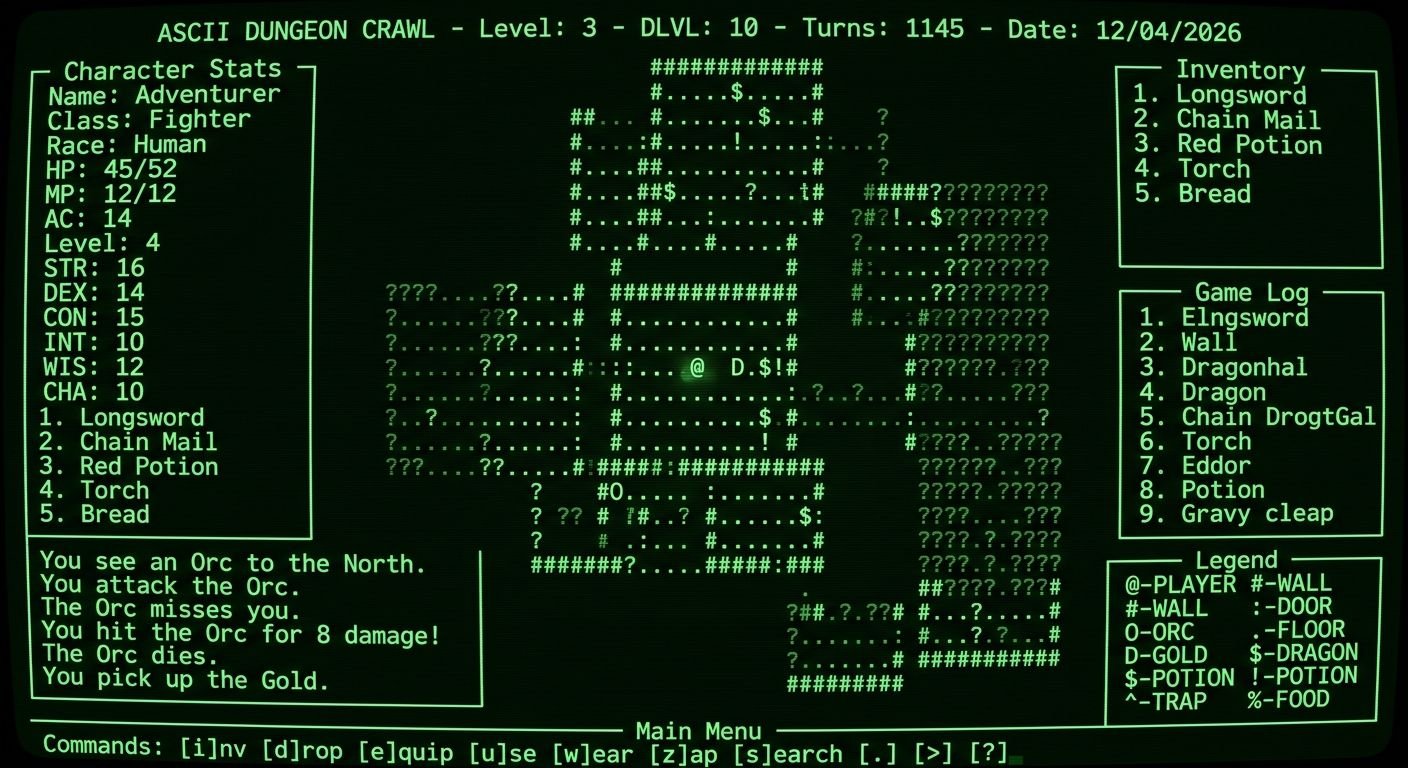
A roguelike is a game built around repeated runs, changing challenges, and meaningful consequences when your character fails. Traditional roguelikes usually combine procedurally generated levels, permanent death, turn-based combat, grid-based movement, exploration, and resource management.
Modern games often use the term more broadly. They may borrow the repeated-run structure while adding real-time combat, platforming, deckbuilding, shooting, or permanent upgrades. These games are often called roguelites, although many players use “roguelike” as an umbrella term for both styles.
The word comes from Rogue, a 1980 dungeon-crawling game that helped establish the genre’s best-known ideas: changing dungeon layouts, high-stakes decisions, limited resources, and starting over after death.wikipedia+1
How Roguelike Games Work
A typical roguelike game is organized around a run.
1. Start with limited abilities
You begin with a basic character, weapon, deck, squad, or set of tools. You usually do not have every ability unlocked at the start.
2. Enter a changing environment
The game creates a level, route, room sequence, or encounter list using procedural rules. The exact layout, enemies, rewards, or events may differ each time you play.
3. Make risk-and-reward decisions
You decide whether to:
- Fight a dangerous enemy.
- Take a less predictable route.
- Spend a healing item.
- Choose a powerful but unreliable upgrade.
- Visit a shop or save resources.
- Explore for rewards or move toward safety.
4. Build temporary power
During a run, you may collect:
- Weapons.
- Abilities.
- Cards.
- Relics.
- Currency.
- Armor.
- Spells.
- Temporary stat boosts.
These usually help you survive the current attempt.
5. Face stronger challenges
Enemies, traps, puzzles, bosses, or resource shortages become more demanding. Your build may become powerful, but a poor combination of items or one bad decision can still end the run.
6. Die or complete the objective
If your character dies, the run usually ends. You return to the beginning with a new layout, build, or series of choices.
7. Learn and try again
Your knowledge becomes a lasting advantage. You learn enemy patterns, item effects, useful routes, and better ways to manage risk.
Some modern games also preserve currency, story progress, upgrades, or unlocks between runs. That persistent progress is one reason they are often described as roguelites.
Core Features of a Traditional Roguelike
Procedural generation
Procedural generation means that software creates some game content through rules, algorithms, seeds, or templates rather than placing every element manually.
It may generate:
- Dungeon rooms.
- Corridors.
- Enemy positions.
- Item locations.
- Shops.
- Events.
- Map routes.
- Card choices.
- Rewards.
Procedural generation does not mean that everything is meaningless or completely random. Good systems use rules that create variety while keeping the game playable.
For example, a dungeon generator may place rooms differently in every run but still ensure that the player can reach the exit, find essential resources, and encounter a reasonable mix of threats and rewards.
Permadeath
Permadeath means that death ends the current character or run. You usually cannot reload a previous save to continue from the same moment.
However, permadeath does not always mean that absolutely everything disappears. A game may allow you to keep:
- Story scenes.
- Unlocked characters.
- New weapons.
- Permanent currency.
- Cosmetics.
- Achievements.
- Player knowledge.
- Long-term upgrades.
In a strict traditional roguelike, most character and run progress resets. In a roguelite, some form of meta-progression commonly survives.
Turn-based gameplay
Classic roguelikes are often turn-based. The player takes an action, and the game responds. Moving, waiting, attacking, or using an item advances the situation.
Turn-based design gives you time to:
- Study enemy positions.
- Count movement options.
- Plan an escape.
- Compare resource costs.
- Predict an opponent’s next action.
- Think through the consequences of a mistake.
Many modern roguelites use real-time combat instead, so turn-based play is common in traditional roguelikes but not required in the broad modern use of the term.
Grid-based movement
Traditional roguelikes commonly use a grid. The player, enemies, and objects occupy tiles, and movement occurs from one tile to another.
This supports:
- Tactical positioning.
- Line-of-sight decisions.
- Chokepoints.
- Range management.
- Precise enemy movement.
- Puzzle-like combat.
Some modern games use free movement rather than a visible grid, which is one reason they are often categorized as roguelites or roguelike-inspired games.
Resource management
Resources make decisions matter. You may need to manage:
- Health.
- Food.
- Ammunition.
- Potions.
- Equipment durability.
- Currency.
- Energy.
- Spells.
- Safe opportunities to rest.
A strong player does not only ask, “Can I win this fight?” They also ask, “What will this cost me, and will I have enough left for the next area?”
Exploration and discovery
Many roguelikes hide information from the player. You may not know what an item does, where a corridor leads, or which enemy is safe to approach.
Discovery can involve:
- Testing unknown items.
- Learning enemy behavior.
- Finding hidden rooms.
- Identifying map patterns.
- Discovering interactions between systems.
- Recognizing which risks are worth taking.
The knowledge you gain can remain useful even after the current character dies.
Systemic interactions
Traditional roguelikes often contain systems that interact in unexpected ways. Fire may spread, water may extinguish flames, a spell may affect several creatures, or an item may have uses beyond its obvious purpose.
This creates emergent gameplay: situations that arise from the interaction of rules rather than from one scripted sequence.
Where the Term Came From
The influence of Rogue
Rogue is generally considered the namesake and foundational influence of the roguelike genre. It placed players in a procedurally generated dungeon and required them to make careful decisions with limited information and resources.
The game’s structure made every run different. A player could not simply memorize one correct route because the environment and encounters changed.
Later games expanded the idea, including:
- Hack.
- NetHack.
- Moria.
- Angband.
- ADOM.
- Dungeon Crawl Stone Soup.
These games helped develop the traditional form of the genre, especially its turn-based movement, grid-based environments, complex systems, and severe consequences for failure. According to Wikipedia’s overview of the roguelike genre, the style traditionally centers around a challenging dungeon crawl featuring procedural levels and permanent character death.
The Berlin Interpretation
In 2008, developers and enthusiasts discussed a framework known as the Berlin Interpretation. It identified high-value and low-value characteristics associated with traditional roguelikes.
High-value characteristics commonly include:
- Random environment generation.
- Permadeath.
- Turn-based gameplay.
- Grid-based movement.
- Non-modal interaction.
- Complexity.
- Resource management.
- Hack-and-slash combat.
- Exploration and discovery.
The Berlin Interpretation is useful for discussing how closely a game resembles classic roguelikes. It is not an official rating system or a universally enforced definition. Academic writing describes it as a framework with nine high-value and six low-value factors.
Roguelike vs. Roguelite
What is the difference?
The roguelike vs roguelite debate usually focuses on how closely a game follows the original design traditions of Rogue.
| Feature | Traditional roguelike | Modern roguelite |
| Death | Usually ends the current character and run | Ends the run, but some progress may remain |
| Combat | Often turn-based | Frequently real-time |
| Movement | Commonly grid-based | May use platforming, shooting, or free movement |
| Environment | Often procedural dungeon layouts | May use procedural rooms, stages, routes, or events |
| Progression | Run-specific growth and player knowledge | Often includes permanent upgrades or unlocks |
| Structure | Usually an RPG or dungeon crawl | Can combine with action, cards, survival, strategy, or racing |
| Examples | NetHack, ADOM, Dungeon Crawl Stone Soup | Examples include Hades, Dead Cells, Risk of Rain 2, and Slay the Spire. |
A roguelite generally keeps the repeated-run structure but adds another genre and allows some progress to carry over after death.
This distinction is useful, but it is not absolute. Some games sit between the categories, and different communities use the words differently.
Is Hades a Roguelike?
Hades is commonly classified as a roguelite because it combines:
- Repeated escape attempts.
- Changing room sequences.
- Run-ending death.
- Real-time combat.
- Persistent story progression.
- Permanent upgrades and unlocks.
Many players still call it a roguelike in the broad sense because its main gameplay loop depends on repeated runs, randomized challenges, and learning through failure.
The classification depends on how the term is defined:
- Under a strict traditional definition, Hades is not a classic roguelike.
- Under modern everyday usage, it is often grouped with roguelike games.
- The more specific label “action roguelite” describes its structure more clearly.
What Happens When You Die?
Do you lose everything?
Usually, you lose the current run’s temporary progress.
That may include:
- The current map.
- Temporary weapons.
- Run-specific currency.
- Temporary abilities.
- Character levels.
- Items collected during that attempt.
- The current build.
You may retain:
- Player knowledge.
- Story progress.
- Permanent currency.
- Character unlocks.
- New weapons.
- Passive upgrades.
- Achievements.
- Cosmetic items.
Example
Imagine reaching the third area with a powerful weapon and several strong abilities. A boss defeats you, so the run ends. In a traditional roguelike, you may return to the beginning with a new character and no equipment from that attempt.
In a roguelite, you may return to a hub with new dialogue, permanent currency, unlocked equipment, or improved starting options. The failed run still advances the broader game.
That difference is central to the modern distinction between roguelike and roguelite.
Why People Enjoy Roguelikes
Roguelikes appeal to players who enjoy:
- High-stakes decisions.
- Replayability.
- Experimentation.
- Build variety.
- Strategic planning.
- Emergent interactions.
- Learning from failure.
- Procedural environments.
- Skill improvement.
- Short or repeatable play sessions.
A successful run can feel satisfying because the player adapted to changing circumstances rather than simply memorizing a fixed level.
The genre also makes small decisions meaningful. Choosing one reward over another can affect the entire run, especially when resources are limited and there is no guaranteed way to undo the choice.
Are Roguelikes Always Difficult?
Many roguelikes are challenging, but difficulty alone does not define the genre.
The challenge may come from:
- Limited healing.
- Unpredictable encounters.
- Incomplete information.
- Permanent death.
- Resource shortages.
- Risk-and-reward choices.
- Powerful but fragile builds.
- Increasing enemy strength.
- The need to understand complex systems.
A roguelike can still include accessibility settings, difficulty options, tutorials, generous unlocks, or persistent upgrades. A game does not stop being roguelike-inspired simply because it is designed to be approachable.
Examples by Style
Traditional roguelikes
These stay close to the original design traditions:
- Rogue.
- NetHack.
- ADOM.
- Angband.
- Dungeon Crawl Stone Soup.
They typically emphasize turn-based decisions, grid movement, procedural environments, permanent death, and systemic interactions.
Action roguelites
These use real-time combat and fast movement:
- Hades.
- Dead Cells.
- The Binding of Isaac.
- Enter the Gungeon.
- Risk of Rain 2.
- Returnal.
They may include persistent unlocks, story progress, or new options between runs.
Roguelike-inspired hybrids
These combine repeated-run systems with another genre:
- Slay the Spire: deckbuilding and turn-based battles.
- FTL: Faster Than Light: strategy, events, and resource management.
- Balatro: poker-based deckbuilding.
- Vampire Survivors: automatic attacks and survival waves.
- Darkest Dungeon: party management and high-risk expedition structure.
These games may be called roguelikes, roguelites, or simply roguelike-inspired games depending on the writer and community.
How to Choose Your First Roguelike
Choose based on the kind of gameplay you already enjoy.
| If you enjoy… | Start with… |
| Careful planning | A traditional turn-based roguelike |
| Fast action | An action roguelite |
| Cards and strategy | A roguelike deckbuilder |
| Exploration | A dungeon or survival hybrid |
| Short arcade runs | A score-focused roguelite |
| Story progression | A roguelite with persistent narrative |
| Complex systems | A traditional dungeon roguelike |
| Experimentation | A game with varied builds and item combinations |
Before choosing, ask:
- Do you prefer real-time or turn-based combat?
- Are you comfortable losing a run?
- Do you want permanent upgrades?
- Do you prefer story or systems?
- How much complexity do you enjoy?
- Do you want short runs or longer attempts?
Common Misunderstandings
Every roguelike is turn-based
Traditional roguelikes often are, but modern roguelites may use real-time combat.
Everything is completely random
Procedural generation usually follows rules. The game creates variety within designed boundaries.
Permadeath means nothing carries over
A run may reset while story progress, unlocks, currency, or player knowledge remain.
Roguelike and roguelite mean exactly the same thing
Some players use the words interchangeably, but many use roguelite for modern hybrids with persistent progression or real-time action.
The Berlin Interpretation is an official genre law
It is a community framework for discussing traditional features, not a binding standard.
Frequently Asked Questions
What is a roguelike game in simple terms?
A roguelike is a game built around repeated runs, changing environments or encounters, and meaningful consequences when the player dies. Traditional examples often include procedural generation, permadeath, turn-based play, and grid-based movement.
Why is it called a roguelike?
The name comes from Rogue, a 1980 dungeon game that influenced the genre’s procedural levels, permanent death, exploration, and resource-management systems.
What Is the Difference Between Roguelike and Roguelite Games?
A traditional roguelike usually stays closer to Rogue, with turn-based, grid-based play and major resets after death. A roguelite borrows the repeated-run structure but often adds real-time combat, persistent upgrades, or another genre’s mechanics.
Is Hades a roguelike or roguelite?
Hades is commonly classified as an action roguelite because it uses real-time combat and preserves story and upgrade progress between runs. Many gamers also refer to it as a roguelike when speaking more generally.
Are all roguelikes turn-based?
No. Turn-based gameplay is common in traditional roguelikes, but modern roguelike-inspired games frequently use real-time action.
Do you lose everything when you die?
You usually lose progress from the current run, including temporary items and abilities. Some games preserve story progress, unlocks, currency, upgrades, or other meta-progression.
Are roguelikes always dungeon crawlers?
No. Modern roguelike structures appear in card games, platformers, shooters, survival games, strategy games, and space simulators.
Conclusion
A roguelike game is built around repeated runs, changing challenges, and meaningful consequences for failure. Traditional roguelikes usually combine procedural generation, permadeath, turn-based combat, grid-based movement, resource management, and exploration.
Modern games often use the broader roguelite label when they add real-time action, persistent upgrades, or mechanics from another genre on our homepage. So when deciding whether a game is a roguelike, look beyond the store label: check what changes between runs, what happens when you die, and what progress remains afterward.











