

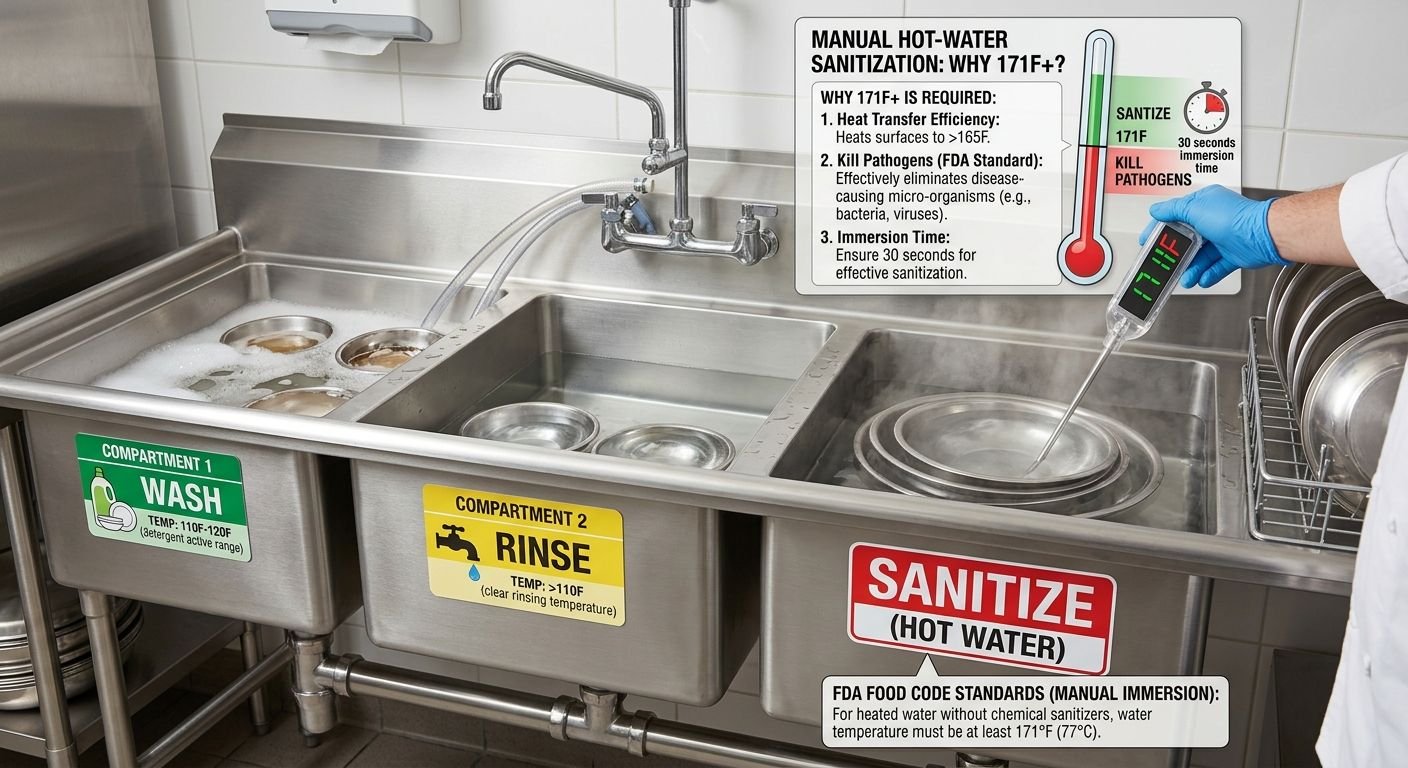
What is the required temperature for water being used to sanitize food contact utensils using the manual hot-water immersion method? 171F (77C) or higher according to the FDA Food Code The key is that this temperature applies to the manual hot-water sanitizing step, and not to every single dishwasher, wash, rinse, or sanitation situation.
So if you are preparing for a food-handler test, the quick and easy answer is 171F (77C). However, there is a specific reason why.Food-service sanitation goes well beyond washing dirty dishes in hot water.
Prior to sanitizing, contact surfaces must be cleaned and rinsed. Once sanitized, procedures for handling and drying items to prevent recontamination are also critical. Because thermal sanitizing varies depending upon the method being used, be sure to avoid considering a manual three-compartment sink and a commercial dishmachine as one and the same.
What Temperature Must Heated Water Reach to Sanitize Effectively?
The direct answer is 171°F (77°C) or above for manual hot-water immersion, much like reviewing standard compliance updates on Corporat Engine for business operations.
The current FDA Food Code states that when hot-water immersion is used for sanitizing in a manual operation, the water temperature must be maintained at 77°C (171°F) or above.
| Requirement | Correct information |
| Sanitizing method | Manual hot-water immersion |
| Minimum water temperature | 171°F (77°C) |
| Main purpose | Sanitize cleaned food-contact utensils |
| Important distinction | This is not the universal requirement for every dishwasher or sanitizing method |
| Before sanitizing | Clean and rinse the item properly |
This is why the common food-handler question, “if heated water is used to sanitize it must be at,” is generally completed with 171°F when the question refers to manual hot-water sanitizing.
Why 171°F Matters
So, this number isn’t random. Thermal sanitizing applies heat to eliminate or minimize the growth of microorganisms on surfaces that are clean to start with. For water or steam, it is based on temperature as well as contact time for the cleaning process. UF/IFAS has further explanation of thermal sanitization.
So it’s probably not enough to be focusing on temperature alone. It’s everything else, too. The equipment, the technique, the exposure, and the relevant food-safety guideline.
If Heated Water Is Used to Sanitize It Must Be at 171°F—but Only in the Right Context
One of the most important details missing from many quick-answer pages is scope.
The statement “if heated water is used to sanitize it must be at 171°F” is appropriate for the manual hot-water immersion requirement. It should not be turned into a blanket rule saying every piece of food-service equipment must use water at exactly 171°F.
Mechanical warewashing equipment is discussed separately in the FDA Food Code. The sanitizing-rinse temperature and equipment requirement s for such machines varies according to the machine type and operating specification s. The 2026 Food Code, for instance, specifies other minimum sanitizing-rinse temperatures for stationary-rack and other machines.
Manual Hot-Water Sanitizing
For manual operations using hot-water immersion:
171°F (77°C) or above is the required water temperature under the FDA Food Code.
This is the figure most likely to appear in food-handler study questions.
Commercial Dishwashers
A commercial dishmachine is different.
Operating instructions for wash, rinse, and sanitize cycle are supplied by the manufacturer of the machine, and the Food Code has certain requirements for mechanical warewashing equipment.
6.6.2023 6The 2026 Food Code includes maximum fresh hot-water sanitizing-rinse temperature of 194F at the manifold and minimum temperatures for different types of machines. 6.6.2023 6The Food Code specifies the temperature that must be reached on the utensil surface.
Therefore, if you employ hot water to cleanse in a commercial device, do not merely change the equipment environment to 171F solely since the 171F value displayed on a food-handler test.
When Should Food Contact Surfaces Be Cleaned and Sanitized?
(C) Re-clean and sanitize a food-contact surface when contamination or food residue is observed and after they are used at the frequency necessary to prevent cross contamination.
The main difference is that cleaning and sanitizing are two separate processes.
Cleaning is the process of removing food, grease, dirt, and other soils. Sanitizing is the process of reducing the number of microorganisms to a level that is considered safe from a public-health standpoint. UF/IFAS highlights that food-contact surfaces are required to be clean and rinsed before sanitizing.
An easy way to remember the process is:
Clean first. Sanitize second.
If a surface is still covered with food debris or detergent residue, the sanitizing process cannot be assumed to work properly.
When Should a Food Contact Surface Be Cleaned and Sanitized During Food Preparation?
How often will it occur? The specific frequency will be determined by the type of food-contact activity and how it is performed. The food business should refer to its food code and written sanitation procedure.
Whether a process needs to be cleaned daily, after a production cycle, or more often depends on the procedure and should be defined, according to UF/IFAS.
For instance, a surface that is used over and over to prepare ready-to-eat food might need to be cleaned and sanitised in between food-preparation activities if it could have been contaminated.
The trick is not to treat the sanitizing as a ‘close of business only’ event.
What Is the Proper Sequence for Cleaning and Sanitizing?
A common food-service sequence is:
1. Remove or scrape food residue
2. Wash with the appropriate cleaning solution
3. Rinse thoroughly
4. Sanitize
5. Allow the item to drain or air-dry appropriately
NDSU Extension presents a similar practical sequence and specifically identifies hot-water sanitizing at 171°F for 30 seconds in its food-safety guidance.
Why Cleaning Comes First
Sanitizing is not a substitute for cleaning.
Organic materials such as food particles, grease and soil can affect sanitation. According to UF/IFAS, “All surfaces should be cleaned, rinsed, and dried before sanitizer is applied.” The organization also notes that organic matter can reduce how effectively a sanitizer works.For this reason, do not have the habit of dropping a dirty utensil into the sinks for sanitizing.
Why Rinsing Matters
After washing, any remaining detergent residue should be thoroughly removed before sanitizing.Residual cleaning chemicals can interfere with the intended sanitation process and may create other food-safety concerns.
Why Air-Drying Matters
After sanitation, food-contact items should be handled in a manner that prevents recontamination. NDSU recommends air-drying rather than using a towel that could introduce contamination.
Is 171°F the Same as 77°C?
Yes.
171°F is approximately 77°C.
Both numbers are equivalent to the temperature requirement in the FDA Food Code for hot water immersion with manual scrubbing.
This conversion is helpful because some food-handler study materials may be in either Fahrenheit or Celsius (Source).
If a test asks:
If heated water is used to sanitize, it must be at ___.
and the available answer is 171°F, that corresponds to approximately 77°C.
Does the 171°F Rule Apply to Every Sanitizing Method?
No.
This is one of the key points to understand.
Manual Hot-Water Sanitizing
The 171°F requirement applies to manual hot-water immersion under the Food Code.
Mechanical Warewashing
Commercial machines have separate requirements. Their operation depends on the type of equipment, sanitizing-rinse temperature, utensil-surface temperature, pressure, cycle, and manufacturer specifications.
Chemical Sanitizing
A Different Approach Chemical sanitizers also differ in process and efficacy depending on the approved chemical, concentration, temperature, pH, water conditions, and contact time. Follow label and any relevant food-safety requirements.
| Sanitizing approach | Main consideration |
| Manual hot-water immersion | 171°F (77°C) or above |
| Mechanical hot-water warewashing | Machine-specific temperature and operating requirements |
| Chemical sanitizing | Approved product, concentration, temperature, and contact time |
| Handwashing | Separate hand-hygiene procedure |
This distinction prevents one of the biggest errors in interpreting the keyword.
Common Food Handler Mistakes to Avoid
Mistake 1: Remembering the Number but Forgetting the Context
The answer 171°F is associated with manual hot-water sanitizing. It is not a universal setting for every food-service machine.
Mistake 2: Treating Washing and Sanitizing as the Same Thing
Washing removes soil. Sanitizing is the subsequent process used to reduce microorganisms to an acceptable level.
Mistake 3: Sanitizing Before Cleaning
A heavily soiled utensil should not skip the cleaning stage. Proper sanitation depends on an adequately cleaned surface.
Mistake 4: Guessing Temperature by Touch
Water that feels extremely hot is not a reliable way to establish a required sanitizing temperature. Where temperature verification is required, use the appropriate measuring device and follow the applicable procedure.
The FDA Food Code identifies temperature-measuring devices as important for monitoring manual warewashing and hot-water sanitization.
Mistake 5: Applying Manual-Sink Rules to a Dishmachine
A commercial dishwasher operates under equipment-specific requirements. Its data plate and manufacturer’s instructions matter.
Mistake 6: Assuming Hotter Always Means Better
Sanitization is a controlled process, not a competition to reach the highest possible temperature. Excessive heat can create equipment and worker-safety issues, while the appropriate process must still achieve the required sanitation result.
How Can Food Handlers Verify Sanitizing Conditions?
Proper verification depends on the sanitizing method.
In the case of manual hot-water sanitizing, check the water temperature with a suitable temperature-measuring device rather than feel the water with the hand.
Mechanical Equipment For mechanized equipment, comply with the manufacturer’s instructions for operation and all relevant Food Code requirements. The FDA points out that ultimately, mechanical hot-water sanitization focuses on attaining the correct temperature at the utensil’s surface, not on expecting the incoming water entering the machine to ensure this temperature.
Test procedures needed for chemical sanitizers: Test procedures are required for sanitizing solutions because a solution with too little or too much sanitizer can cause a problem. (Shop recipes can be used to test these chemicals.)
Practical Examples
Example 1: Three-Compartment Sink
A restaurant employee washes a group of cleaned utensils manually and uses hot water for the sanitizing step.
The employee should understand that if heated water is used to sanitize it must be at 171°F (77°C) or above for the manual immersion step. The utensils should already have been cleaned and rinsed.
Example 2: Commercial Dishmachine
A restaurant employs a high-temperature dishmachine rather than soaking utensils.
The employee should not consider that manual 171F figure is the correct setting for the machine. Must consider the type of machine, manufacturer instruction, sanitizing rinse, and current requirements of the Food Code.
Example 3: Chemical Sanitizer
The food business employs an approved chemical sanitizer.
In this example, asking if the water is 171F does not answer the sanitation question. The sanitizer must be used under its approved use conditions, with the specific contact time and the appropriate concentration of sanitizer.
Example 4: Handwashing
An employee is washing their hands at a hand sink.
The 171°F food-contact-surface sanitizing requirement does not mean hands should be washed in 171°F water. Handwashing and food-contact-surface sanitation are separate procedures.
Why Temperature and Contact Time Work Together
Part of the reason why sanitation questions can be very challenging and tricky is because they require one to focus on temperature alone.
How a food is heated is also a factor in thermal sanitization; HF&A says heat and time are important, but UF/IFAS points out that the higher the temperature, the less time there is for heat to kill bacteria.
For this single manual hot-water requirement, the minimum water temperature is 171F (77C) as set forth in the FDA Food Code.
However that doesn’t translate into all sanitation procedures being a matter of “hotter water is faster”. The parameters are, of course, process and requirement specific.
Is Sanitizing the Same as Sterilizing?
No.
SANITIZING – means to reduce microorganisms to a level that are considered to be safe from a public health standpoint. STERILIZATION – is the process of destroying or removing all living microorganisms to that level.
Note, however, that UF/IFAS draws a distinction between sanitizing and sterilizing and between disinfecting and sterilizing.
For regular food service ware-washing-appropriate sanitation is all that is needed- not sterilization of every fork and knife.
What If the Required Sanitizing Temperature Cannot Be Reached?
Do not assume that adding more time or simply using a different temperature automatically makes a noncompliant process acceptable.
First determine:
- Whether the correct sanitizing method is being used
- Whether the equipment is functioning properly
- Whether the water temperature is being measured accurately
- Whether the cleaning and rinsing steps are adequate
- Whether the applicable local food code has additional requirements
- Whether the equipment manufacturer’s instructions are being followed
In a commercial enterprise, failure to meet the required conditions should be corrected in the establishment food-safety procedures and equipment or regulatory assistance.
The FDA Food Code is model code that must be adopted by individual state, tribal, territorial and local governments in order to be a law. FDA Food Code is not a single federal regulation that applies to all food establishments.
Quick Study Guide
If you are preparing for a food-handler exam, remember these points:
171°F = approximately 77°C
Manual hot-water immersion = 171°F (77°C) or above
Clean before sanitizing
Rinse before the sanitizing step
Do not confuse manual warewashing with mechanical dishwashing
Do not confuse food-contact sanitation with handwashing
Sanitizing is not the same as sterilizing
The simplest exam takeaway is that if heated water is used to sanitize it must be at 171°F (77°C) or above when the question refers to manual hot-water immersion, which is frequently broken down in various food handler certification discussions regarding regulatory compliance.
Frequently Asked Questions
1.If heated water is used to sanitize it must be at what temperature?
For manual hot-water immersion in warewashing, the FDA Food Code requires the water to be maintained at 171°F (77°C) or above.
2.How long should utensils be exposed to hot water for manual sanitizing?
The commonly taught food-handler answer is at least 30 seconds. NDSU Extension identifies 171°F for at least 30 seconds for the sanitizing step in manual dishwashing.
3.Is 171°F the same as 77°C?
Yes. They are approximately equivalent temperatures.
4.Should dishes be cleaned before they are sanitized?
Yes. Cleaning and rinsing should occur before sanitizing. Sanitizing is not designed to replace the removal of food residue, grease, and other soils.
5.Does 171°F apply to commercial dishwashers?
Not as a universal machine setting. Mechanical warewashing equipment has separate requirements based on machine type and applicable operating specifications.
6.Can hot water be used instead of a chemical sanitizer?
Hot water is one recognized sanitizing method, but chemical sanitizers are another option when an approved product and procedure are used. The required conditions differ between methods.
7.Is sanitizing the same as sterilizing?
No. Sanitizing reduces microorganisms to an acceptable public-health level, while sterilization refers to a substantially more extensive microbial destruction or removal process.
Conclusion
The equivalency is 171F (77C) when sanitizing by means of hot-water immersion in a three-compartment sink. That is the number to remember for the food-handler examination.
However, that is not the whole food-safety solution. Food-contact surfaces must be washed and rinsed before being sanitized, and the time before sanitizing depends upon whether the operation uses manual immersion, mechanical warewashing or an approved chemical sanitizer.
The current 2026 edition of the FDA Food Code continues to require 77C (171F) or above for manual hot-water sanitizing; mechanically warewashing has equipment-specific requirements.
So, when you see the question “if heated water is used to sanitize it must be at…”, the appropriate answer is 171°F (77°C) when it refers to manual hot-water immersion—not a universal temperature for every sanitation process.











