

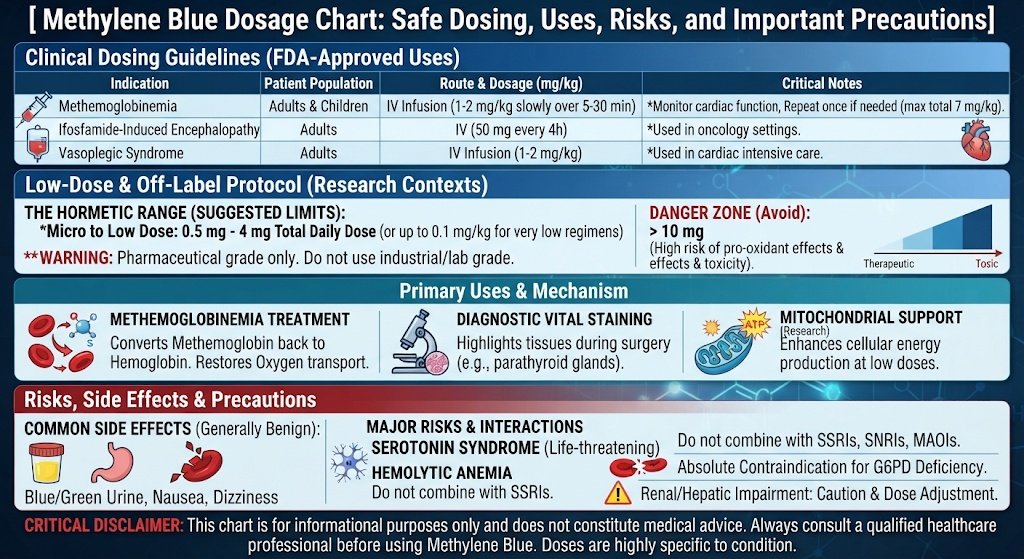
Searching for a methylene blue dosage chart can be confusing because the appropriate amount depends on why the medication is being used, the formulation, the patient’s weight, kidney function, and other medical factors. Methylene blue is not an agent to just arbitrarily dose from a chart obtained online – there are many uses and preparations with markedly different dosing instructions. Injectable methylene blue is available in the US for treatment of acquired methemoglobinemia; a disorder in which hemoglobin is unable to carry oxygen. The prescribed information to treat a patient dictates a weight-based infusion dose as well as guidance regarding re-administration if a repeat dose is indicated.
G6PD deficiency requires consideration and, as always, the information includes warnings for drug interactions that may have significant and potentially fatal consequences if serotonergic agents or opioids are also in use.
This review attempts to outlines prescribed dosing, how much to treat, where a general chart may deceive you, and safety issues to be identified before administering treatment.
What Is Methylene Blue Used For?
Methylene blue is a chemical substance which has a number of medical and laboratory applications. The only Food and Drug Administration-approved indication for the injectable use of methylene blue in the U.S. Is to treat acquired methemoglobinemia in adults and children.
Acquired methemoglobinemia is a condition in which the oxygen-carrying pigment in red blood cells (hemoglobin) is turned into methemoglobin, which cannot deliver oxygen to the body’s tissues.
Symptoms of acquired methemoglobinemia, depending on the cause and severity, include head pain, lightheadedness, lethargy, shortness of breath, confusion or an bluish appearance of the skin. Acquired methemoglobinemia can be induced by chemicals, drugs or other agents causing oxidization. Because treatment is based on the cause and severity, an experienced clinician should determine whether methylene blue is to be given. There is also a distinction to be made between pharmaceutical grade methylene blue and that sold for industrial or other non-medical uses.
A person should always read product labels and be sure the product is approved for its intended use, at the appropriate dose, and concentration.
Methylene Blue Dosage Chart for Acquired Methemoglobinemia
The recommended first dose of the FDA-approved injectable product for acquired methemoglobinemia is described in the official methylene blue prescribing information, which also provides important administration and safety details. If methemoglobin levels continue to be > 30% and the patient’s signs and symptoms persist, then the patient can receive the drug for a second dose of 1 mg/kg an hour after the initial dose.
A simplified reference looks like this:
| Treatment stage | Labeled dosage framework |
| Initial treatment | 1 mg/kg IV |
| Administration time | 5–30 minutes |
| Possible repeat dose | 1 mg/kg after 1 hour if criteria remain present |
| Maximum recommended doses | Generally 2 doses |
| Moderate or severe renal impairment | Single 1 mg/kg dose |
This table represents the labeling information. It is not a guide to an individualized recommended dose. It is the responsibility of the prescribing physician to evaluate the patients’s condition, weight, laboratory results, methemoglobinemia etiology, kidney function and medications and contraindications to determine the patients correct dose.
Current labeling also states if methemoglobinemia is not resolved after two doses consideration of other management methods should be evaluated instead of automatic repeated doses.
Why Weight Matters
Rather than giving 5mg for everyone, the dose in the prescription is prescribed in mg/kg (which you can think of as x milligrams per kilogram bodyweight). Thus the dose that the patient will get is appropriate for their weight. A doctor working out the dose based on the patient’s weight would divide the patient’s weight by the prescription-dose in mg/kg to get the answer (e.g. 4kg and dose of 50mg/kg = 200mg dose. This should of course be worked out and checked by health professionals due to the risk of drug error).
One other point to take into account is the concentration of the vial or ampule – many of today’s liquid products are labelled as 5mg/ml on a range of sizes of vial/container. This means that 1ml of the 5mg/ml solution contains 5mg, not that 1mg should be given. You cannot give mg and ml the same values when this occurs and this mixing up of dose and concentration is how online dosing calculators can kill.
How Clinicians Decide Whether Another Dose Is Appropriate
The second dose is not a “perfunctory” second stab because the patient already had the first one. The drug labeling may give another dose of 1 mg/kg in one hour if the methemoglobin remains at greater than 30%, or if symptoms persist. You won’t typically rely solely upon the methemoglobin concentration alone because treatment choices are made based on a patient’s status, suspected cause of methemoglobinemia, response to treatment, and other possible strategies.
If the patient doesn’t respond well, there may be an alternative cause.
Therefore, theFDA label states that “themethemoglobinemia failing to respond or recurring may happen in some kinds of poisonings.” You must reconsider alternative, or additional interventions, instead of jumping to the second guess at self administration.
Renal Impairment Changes the Dosing Approach
Also in the equation here is kidney function. The present prescribing information recommends a one-time 1 mg/kg dose in the moderate or severe setting in labeling, where moderate or severe renal impairment is described as an estimated glomerular filtration rate (eGFR) of 15 to 59 mL/min/1.73 m. The labeling states that in instances where a condition does not adequately respond to the dose one hour later, the labeling then recommends discussing alternatives instead of automatically administering a subsequent dose.
This situation serves as a perfect illustration of why a generic dosing calculator absolutely cannot substitute for clinical judgment.
Somebody’s weight may be known, for example, but the fact that their kidney status dictates a different course of action may be unknown. Furthermore, other medical conditions or concomitant medications may exist that modify the overall potential risks associated with methylene blue therapy.
G6PD Deficiency Is a Major Safety Concern
Among the serious cautions pertaining to injectable methylene blue, is the caution relating toGlucose-6-Phosphate Dehydrogenase Deficiency, likewise known as G6PD deficiency. The labeling to day identifies G6PD deficiency as a contraindication, given thatmethylene blue can generate extreme hemolysisand severe anemiain G6PD deficient clients; moreover, treatment might not work. Because G6PD deficiency, clients are less efficient converting methylene blue into its inactive state.
Hemolysismeans red cell breakdown is quickgoing higher than the rate of substitute.
Hemolysis which is intense can turn into a medical emergency. This, obviously, becomes especially real for clients who examine a online dosage chart and contemplate whether or not they’ll do calculate a dosage for themselves. Simply understanding the suitable mg/kg size just doesn’t be satisfactory, since the prescription might be suitable for calculating but inappropriate for that 1 patient alone. Medical service employees ought to check the sufferers history previously before treating to establish what medical issues they might have, prior to figuring out any dosage for a drug which could react badly in a sure case and trigger serious damage.
If your individual or client is experiencing this medical situation, you will want to take appropriate steps in the direction of a remedy process.
Drug Interactions Require Careful Review
Methylene blue also has an important interaction risk involving the serotonin system, making information about serotonin syndrome particularly important when reviewing potential medication interactions.
The label carries a boxed warning: Methylene blue may cause serious and potentially fatal serotonin syndrome due to drug interaction with serotonergic drugs and with opioids. Examples of drugs the label notes as contributing to such syndrome:SSRIs and SNRIs such as fluoxetine, sertraline and citalopram, as well as older types like MAOIs. Opioidssuch as oxycodone, morphine and Fentanyl (even at lower doses of Fentanyl).
Symptoms: Agitation and restlessness confused shivering and twitching muscle-stiff, tight or spasmed increased reflexes increased temperature high blood pressure irregular heartbeat fast heart rate seizures Such interactions don’t mean everyone on antidepressants will develop these side effects.
It just does mean a physician reviewing one’s chart needs to address this. One should list everything in terms of pills the patient is taking-prescription and nonprescription, other health substances. Don’t stop an antidepressant or another medication to accommodate this treatment.
Why You Should Not Use an Online Chart for Self-Dosing
A dosage chart can make medication use appear more straightforward than it really is.
For methylene blue, several factors can change the clinical decision:
- The medical indication
- Patient weight
- Methemoglobin level
- Severity of symptoms
- Cause of the methemoglobinemia
- Kidney function
- G6PD status
- Current medications
- Product concentration
- Route of administration
- Response to the first dose
An equally critical distinction is that of an “FDA-indicated” medical usage versus an “off-label,” “experimental,” or “wellness” usage that may be discussed on line. The approved injectable labeling is for acquied methemoglobinemia only.
Do not conflate information on claimed methylene blue uses such as boosting energy, memory, slowing aging or any other potential uses with approved indications dosing.
An injectable formulation should not be taken by mouth. A “non-medical” product should not be injected and intravenous usage should be restricted to the proper medical indications and location.
How Methylene Blue Is Administered
Methylene blue is given I.V. In cases of approved use for acquired methemoglobinemia. The package insert suggests administration IV over a period of 5-30 min and a patent IV line should be used. It is NOT to be given S.C.
This preparation issue is complex in itself. The package insert for the solution indicates 5 mg/ml is provided in a single-use container. It states the solution can be diluted if indicated in Dextrose 5% for patient comfort at the injection site and should be prepared and used immediately upon dilution. It is not to be diluted in solutions containing sodium chloride since the chloride can destabilize methylene blue in solution.
These points show why IV methylene blue should be handled in a strictly controlled environment and dosage is not the only variable of concern for a safe delivery.
What Happens After Treatment?
Care does not necessarily stop when the infusion ends . If, during or shortly after the infusion, symptoms seem to be changing, further investigation is necessary Clinicians want to know whether the levels of methemoglobinemia has improved or whether the symptoms are resolving . They will be alerted to potentially reevaluate for possible alternative etiology if the infusion was not as effective as desired.
Another implication related to the monitoring of the patient is that the drug can cause some difficulty in monitoring the patient.
(1) As specified in the product information: Methylene blue may affect the reading of the pulse oximeter. (7) When pulse oximeter has not provided appropriate monitoring capabilities to satisfy criteria during or post administration of the product an arterial oxygen determination utilizing a testing alternative to the pulse oximetry device may be required (1). This a very relevant clinical point because it should be considered if an individual seems to have impaired oxygen saturations when the infusion is completed.
Common Mistakes With Methylene Blue Dosing
Treating every product as interchangeable
Methylene blue products can have different concentrations, formulations, and intended uses. A laboratory-grade or industrial product should never be assumed to be equivalent to a pharmaceutical injection.
Confusing milligrams with milliliters
A prescribed dose may be expressed in mg/kg, while the vial concentration is expressed in mg/mL. Those measurements describe different things.
Ignoring kidney function

Renal impairment can change the recommended treatment approach. The current labeling specifically limits treatment in moderate or severe renal impairment to a single 1 mg/kg dose.
Overlooking G6PD deficiency
G6PD deficiency is a major contraindication because of the risk of severe hemolytic anemia.
Assuming more medication is better
What if methemoglobinemia doesn’t respond after your sequence of administrations? Then the answer is NOT another dose, because the package insert guidelines suggest other interventions after two doses when the methemoglobinemia has NOT responded.
Using the medication for an unapproved purpose without medical guidance
Online discussions can make experimental uses sound established. Approved dosing information should not be repurposed as a dosing guide for unrelated conditions.
Side Effects and Serious Risks
Methylene blue can produce adverse effects, and some require prompt medical attention.
The prescribing information alerts to hypersensitivity reactions and that there can be a serious allergic reaction to the medication. It points to hemolytic anemia as an issue and also that anemia may arise after treatment for one day or more.
Neurologic and visual reactions are side effects. The labeling prompts the patient to cease any driving or machinery operation untilconfusion, dizziness, and visual abnormalities are resolved.
Interaction with drugs producing other potential syndromes has raised concerns of serotonin syndrome. Symptoms are listed as change of mental state and marked autonomic dysfunction with rigidity and abnormal tone, neuromuscular symptoms, seizures and GI complaints.
Due to the life threatening potential reactions, the medication must be given under strict medical supervision to monitor the patient and intervene when necessary.
When Medical Attention Is Needed
Even suspecting methemoglobinemia could warrant emergency treatment. Blue or gray tint to the skin, unexplained dyspnea (shortness of breath), significant fatigue, changes in mental status (e.g., confusion, drowsiness), vertigo, or symptoms appearing after exposure to an oxidative agent are never an excuse to rely on an online dosing table. The need for emergency care should be clear when the problem is sudden or severe.
Anyone who has already received methylene blue should seek care for such symptoms as severe reactions, breathing trouble, mental status changes, seizures, generalized rigidity, tremors or symptoms suggesting anemia or other complications.
The correct action will then depend on the patients current health and the underlying reasons for concern. The patient will require examination and likely evaluation via blood tests, identification of exposures, measurement of the level of methemoglobin in red cells and consideration of the role of the drug regimen.
How to Read a Methylene Blue Dosage Chart Safely
If you encounter a dosing chart online, use it as a starting point for questions rather than as a prescription.
A safe review process is:
- Identify the exact product. Check whether it is a pharmaceutical formulation and determine its concentration.
- Identify the medical indication. Do not assume dosing for methemoglobinemia applies to another condition.
- Check the prescribed unit. Confirm whether the instructions use mg, mg/kg, or mL.
- Review patient-specific factors. Weight, kidney function, G6PD status, and other medical conditions can matter.
- Review medications. Particular attention is needed for serotonergic medicines and opioids.
- Confirm the route. Approved injectable treatment is administered intravenously, not by an improvised route.
- Follow the current prescribing information. Drug labeling can change, so old charts should not automatically be trusted.
This approach reduces the risk of turning a general reference table into an unsafe self-treatment plan and reinforces the importance of medication safety when evaluating treatment information.
Frequently Asked Questions
1.What is the standard methylene blue dose for methemoglobinemia?
For the FDA-labeled injectable treatment of acquired methemoglobinemia, the standard dose is 1 mg/kg given intravenously over 5 to 30 minutes. A repeat 1 mg/kg dose may be considered one hour later if the methemoglobin level remains above 30% or symptoms persist.
2.Can methylene blue be given to someone with G6PD deficiency?
No. G6PD deficiency is listed as a contraindication for the labeled injectable product because methylene blue can cause severe hemolysis and anemia in affected patients.
3.Is there a different dose for people with kidney problems?
Yes. The current labeling recommends a single 1 mg/kg dose for patients with moderate or severe renal impairment. If significant methemoglobinemia or symptoms persist, alternative interventions should be considered rather than automatically repeating the dose.
4.Can methylene blue interact with antidepressants?
Yes. Methylene blue can interact with serotonergic medicines and may cause serotonin syndrome. The prescribing information specifically warns about SSRIs, SNRIs, MAOIs, and opioids.
5.Is methylene blue safe to take for energy or cognitive benefits?
The FDA-labeled injectable indication is treatment of acquired methemoglobinemia. Dosing for other purposes should not be inferred from the approved methemoglobinemia regimen. Anyone considering methylene blue for another purpose should discuss the risks and evidence with a qualified healthcare professional.
6.Can I calculate my own dose using my weight?
Although the labeled treatment uses a weight-based calculation, that does not make self-dosing appropriate. The clinician must also evaluate the indication, product concentration, kidney function, G6PD status, medication interactions, symptoms, and response to treatment.
7.How many doses can be given?
For acquired methemoglobinemia, the labeling allows a second 1 mg/kg dose when the specified criteria remain present. If the condition does not resolve after two doses, alternative treatment should be considered.
Conclusion
A methylene blue dosage chart can be useful for understanding the general framework of treatment, but it should not be treated as a substitute for medical assessment. The recommended treatment dose in 1mg/kg given over 5 to 30 minutes in the arm, with the possibility of a second dose when needed, is for acquired methemoglobinemia.
Certain underlying factors including kidney function, and G6PD deficiency as well as concomitant drug use, and the source of methemoglobin can influence the use and management of methylene blue. Rely on the information in the package insert/physician insert and the supervision of a healthcare professional, rather than a universal calculator or chart. Methylene blue can cause side effects and should not be used in all individuals, nor when used with interacting medications.











